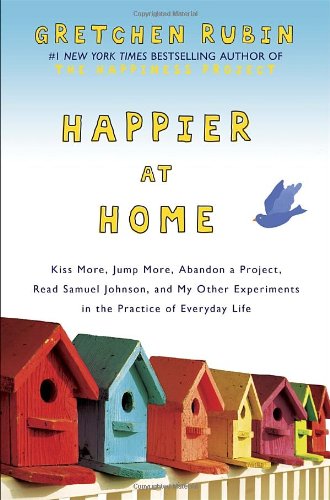

In the spirit of her blockbuster #1 New York Times bestseller The Happiness Project, Gretchen Rubin embarks on a new project to make home a happier place.
One Sunday afternoon, as she unloaded the dishwasher, Gretchen Rubin felt hit by a wave of homesickness. Homesick—why? She was standing right in her own kitchen. She felt homesick, she realized, with love for home itself. “Of all the elements of a happy life,” she thought, “my home is the most important.” In a flash, she decided to undertake a new happiness project, and this time, to focus on home.
And what did she want from her home? A place that calmed her, and energized her. A place that, by making her feel safe, would free her to take risks. Also, while Rubin wanted to be happier at home, she wanted to appreciate how much happiness was there already.
So, starting in September (the new January), Rubin dedicated a school year—September through May—to making her home a place of greater simplicity, comfort, and love.
In The Happiness Project, she worked out general theories of happiness. Here she goes deeper on factors that matter for home, such as possessions, marriage, time, and parenthood. How can she control the cubicle in her pocket? How might she spotlight her family’s treasured possessions? And it really was time to replace that dud toaster.
Each month, Rubin tackles a different theme as she experiments with concrete, manageable resolutions—and this time, she coaxes her family to try some resolutions, as well.
With her signature blend of memoir, science, philosophy, and experimentation, Rubin’s passion for her subject jumps off the page, and reading just a few chapters of this book will inspire readers to find more happiness in their own lives.
Something of a letdown As other reviewers have said, I really wanted to like this book. I loved The Happiness Project, and found it life-changing–in fact, I re-read it at least once a year. I bought copies for family and friends, I recommend it constantly to students in my college writing classes. I love the author and her writing style, too–she is so refreshingly honest, with a wonderfully accessible style.But this book, which I’d eagerly anticipated since I pre-ordered it earlier this summer, feels more like a diary or a The Life of Gretchen Rubin documentary than a self-help book. I love detail, normally, but so much of this book seemed to be “and then this happened to me, and then I did this.” Hard to say how that differs from the first book, but it did–maybe it was the dearth of new insights, or the inclusion of the seemingly trivial (to me, at least). For example, I love scent, too, but the number of pages devoted to Rubin’s exploration of smell, including creating a Shrine to Scent, just seemed like an awful lot of attention spent trying to elevate the incredibly mundane.I do realize that paying attention to the details was a big part of Rubin’s prescription for happiness in her very successful first book, and it’s hard to put my finger on what made this one less enjoyable. I guess in the end it felt as though this one was rushed–that she put in the effort to record the details, but perhaps not the same effort towards making those details add up to something relevant and useful to the reader. Sort of a “This is what I did” rather than “Here’s what to do”–more of a memoir of nine months than the instructional, follow-this-path tone of The Happiness Project. And I love a good memoir–but this wasn’t a good memoir, either. It’s like she didn’t have much significant to say, but still took up a lot of space saying it.If this is your first Gretchen Rubin book, you may not have the same problem with it that I did–I guess I just loved the first book so much that I had very high expectations. I still do, and will look forward to her next project and her next book. But I probably won’t be re-reading this one.
Portrait of a Woman who has it all and is still unhappy I loved The Happiness Project so much that I became a superfan, and wanted to read all I could about Gretchen Rubin. A NY Times article about her, “On Top of the Happiness Racket” revealed how much of her home life she’d kept from readers: husband Jamie is “a senior partner at BC Partners, a hedge fund.” Her “father-in-law, known to readers as the sage, affable “Bob,” is known to the world as Robert Rubin, the former Treasury secretary, who stepped down last year as an adviser to Citigroup.” In Happier at Home, she mentions ‘mortgage papers’; owning a triplex in the Upper East Side means you’re a millionaire.It matters that Ms. Rubin is so wealthy because most of the things that affect my daily happiness at home don’t even register as a blip on her radar. Money is only mentioned when she mentions the expensive family portraits she ordered for the holidays. In many homes, you have to choose between sources of happiness: we can buy an iPad or go away for a long weekend, but not both; we can go out to eat tonight or I can go on a lavish scent shopping spree (which she does), but not both. In many households, a great source of tension is when spouses disagree about how to save and what to buy. She mentions that she’s an under-buyer, but never has to deal with the stress of not being able to buy something, or having to choose between two things. The only restraint that Rubin encounters is not being able to fit in all of her Type-A helicopter mom activities into one afternoon.It also seems that her family is fortunate enough to hire housekeeping help, since the only chores and home maintenance she mentions are activities like tidying up all of her books, organizing trinkets, making photo albums, and painting the home office. Before “building a shrine,” most of us have to do mundane activities like take care of the kids, sweep the floor, clean windows, go grocery shopping, make dinner, do laundry, clean the bathroom, take care of the yard. Doing those things daily–and crossing my fingers that my husband does his share–greatly affect my happiness. *These things are never mentioned in the book.* Rubin’s friends don’t discuss having to make sacrifices, they discuss truffle oil gone bad.As other reviewers have mentioned, this book is very much “this is what I did” instead of “this is what you should do.” This approach failed for me because Rubin’s experience as a millionaire on the Upper East Side means that she is literally living in a different world than I am.The nuts and bolts of the book are much weaker than The Happiness Project: there’s not nearly as much research. She comes across as being very controlling, neurotic and achievement-obsessed; no insights for those of us who have a more relaxed attitude towards life. As a caveat, Rubin has done a great job of curating research, lists and quotes that are relevant, timeless and helpful. A few of these are scattered in the book, but the bulk of the great advice is on her website; skip the book.