
0
0
0
0
0
0
0
0
0
or copy the link
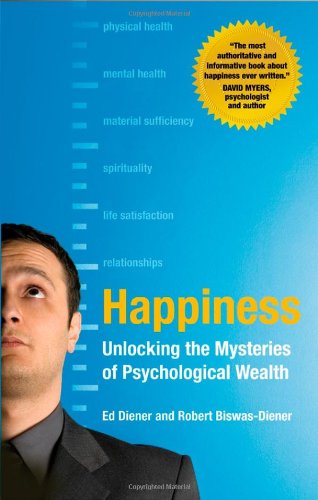
Utilizing sophisticated methodology and three decades of research by the world’s leading expert on happiness, Happiness challenges the present thinking of the causes and consequences of happiness and redefines our modern notions of happiness.
- shares the results of three decades of research on our notions of happiness
- covers the most important advances in our understanding of happiness
- offers readers unparalleled access to the world’s leading experts on happiness
- provides “real world” examples that will resonate with general readers as well as scholars
Winner of the 2008 PSP Prose Award for Excellence in Psychology, Professional and Scholarly Publishing Division of the Association of American Publishers
Well-Balanced, Scientific Book on Happiness I was always wondering if Ed Diener would get around to writing a happiness book for the popular read. For those not in the know, Ed Diener is one of the most well-known happiness researchers out there- and has been contributing to the positive psychology field for literally decades by adding piles of his own research papers to the ever growing stack of happiness studies. Based on a lot of his work that I have read, I figured the book would be pretty sceintific-minded. And I was right- you’ll find no baloney here.”Happiness: Unlocking the Mysteries of Psychological Wealth” contains over 250 pages explaining in layman’s terms, more or less, just about everything you ever wanted to know about happiness. Some of the more interesting topics covered include:-health and happiness-happiness and social relationships-happiness at work-money and happiness-spirituality and happiness-the happiest places on earth-the genetic set point and happinessPerhaps the most impressive thing I found in this book was the author’s attitude about happiness. Here are people who have spent years researching happiness, and yet they seem to have put it all in a sensible perspective. Consider this:–happiness is something to shoot for most of the time, but negative emotions serve a useful purpose as well on occasion–while happiness can be reaching a desirable place, such as having good health, a successful carreer and a great family, don’t overlook the process side of happiness in the pursuit of the good life (this is also a major point of another favorite happiness book of mine Happier: Can You Learn to be Happy?). In other words, happiness isn’t only a destination, but also the journey.–happiness isn’t JUST about feeling good, it is also good for you in a number of other surprising waysWhat more can I say? For anyone looking for a detailed, well-balanced, scientific look at happiness, its a great read. If you’re not into the research-side as much, try “Finding Happiness in a Frustrating World”.
A comprehensive, well-researched manual This book is written by a father-son team, Ed Diener and Robert Biswas-Diener. Both have done extensive research in the happiness field, with latter collecting data–often in a fairly unconventional manner–from around the world. They chose to focus their book on the concept of psychological wealth, which includes not only happiness but also additional factors such as one’s attitude towards life, social support, material resources, and other influences. The authors lay out their book in several parts. Part I simply expands on the concept of psychological wealth and the principles that define it. Parts II and III form the core of the book: in Part II, the authors make the case that happy people function better, particularly in the areas of health, social relationships, and work, and in Part III, they examine the specific causes of happiness. Finally, the last section of the book, Part IV, involves putting everything together, including summarizing the previous concepts and providing various measures of psychological wealth.The authors write in a style that is clear and accessible to a general audience; furthermore, they frequently infuse humor into their work. But less than halfway through the book, I found myself to be surprisingly bored. One of the main ways in which the authors lost me is that they tend to overstate their case to the readers; often I found myself having a reaction along the lines of “yes, yes, I get it already!” In fact, in Chapter 13, “Living Happily Ever After,” the authors offer short summaries of each of the key chapters from Parts II and III of the book, and I found these brief synopses sufficient to convey the most salient and necessary points. Another issue I had is that I’m not sure who, exactly, is the appropriate audience for this book. For the mental health professional like myself (I’m a clinical psychologist), the authors do offer a few new insights into the factors which contribute to psychological wealth, but as mentioned above, they are quite slow to make their points. For the more general reader, the authors provide little in the way of practical applications of their research, with the exception of their AIM theory, or how one chooses to direct one’s attention. Unfortunately, the AIM model does not seem significantly different from the concept of Learned Optimism introduced by the founder of positive psychology, psychologist Martin Seligman, well over 15 years ago.I certainly respect Diener and Biswas-Diener as well as admire the amount effort they have each put into their life’s work. Unfortunately, however, I think that this book fails to truly convey the importance and excitement of that work to the reader. Therefore, my final rating is 3 1/2 stars.