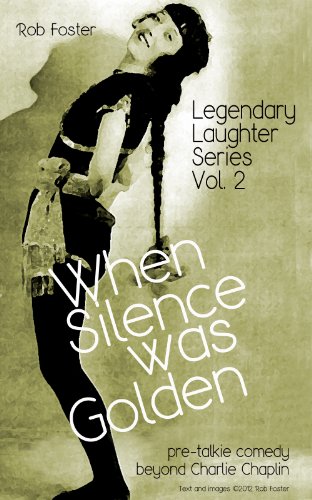

Most people think only of Charlie Chaplin when someone mentions “silent movies.” We’ve forgotten that there were many other funny people in the silent days, and even superstar comedians before Chaplin!
“When Silence Was Golden ” is a bold collection of essays focused on the lives of the great silent comedians who populated Hollywood, but have sometimes been overlooked in film history from having to thrive in the shadow of Charlie Chaplin’s fame.
Intriguing chapters include comprehensive looks at Mabel Normand, Harry Langdon, and Larry Semon, among others. Also included is a fresh take on the infamous Fatty Arbuckle scandal that rocked the nation early in the 20th century – our first major “media-circus!”
“When Silence Was Golden” is a splendid addition to other silent film star biographies in the libraries of fans, and anyone who loves to laugh.
The Legendary Laughter Series highlights classic comedy from the silent era to the television age, engagingly written, revealing the stories behind the laughs – by a lifelong student of the great laughmakers and a fellow practitioner of comedy.
Relax, pull up a whoopie-cushion, and enjoy!
The Evolution of Screen Comedy Mr Foster has created a gem of a little book on the original masters of stage and screen comedy and their impact on those who folllowed in their footsteps. Though sometimes ambling Mr. Foster sheds some much needed light on some of the lesser known, or perhaps, more accurately, lesser remembered stars of the days when words were yet to be spoken. For fans of comedians from the silent years or just comedic actors in general, Mr. Foster has baked up a very readable and fulfilling treat.
Golden Silence of pre-talkie movies… and a bit beyond. This is the author’s second effort in his Legendary Laughter Series, and another fine effort it is.”Pre-talkie” is a perfect description of this era, as most folks now, almost 100 years after it ended, believe that the movie experience of that time was “silent.” Movies were accompanied by music [and in some cases, more] supplied by the movie house itself. Depending on the venue, this accompaniment could range from a simple piano, to pipe organs from the modest to the truly grand, to even live musicians.Like the author’s first effort in his “Legendary Laughter Series” about Ernie Kovacs, this work too, focuses on the “golden” early performers in a new medium. Kovacs’ artistry, done in the early 1960′s, was almost lost for many reasons similar to the almost total loss of the movies of the artists of the pre-talkie era.While Kovacs’ work was lost by “bosses” who did not know what he was and the “recycling” of expensive video tape by using it to record another show; all the artists of the pre-talkie era were almost completely lost due to the fact that once talking-movies took over, the “silent” movie was totally obsolete. The “bosses” had no reason to care about preserving mere “entertainment.” While movie film cannot be recorded over like the magnetic tape of Kovacs’ day, it can be destroyed by simple neglect. Movie film stock until relatively recently was very unstable and will decompose over time. Most movies made on this type film (talkie or not, comedy or not) have been lost due to this simple fact.In this book you will learn about how Buster Keaton discovered how to do multiple exposures to film himself performing with himself, the camera tricks Charlie Chaplin used to be “missed” by an ax, and how Stan Laurel and Oliver Hardy started in movies before they were teamed together. (As well as the fact that sound brought Laurel and Hardy to heights that may not have been possible with out it.)The reader will discover Mabel Normand, probably the first powerful woman in the movies. Normand influenced many areas and was important in giving some future giants of the movie business their first “break” into movies. These performers may, in many cases, have never made it to stardom without her influence. And Mabel appears to have been this influential without the “usual” romantic entanglements.The reader will learn about the first victim of a media scandal: Roscoe “Fatty’ Arbuckle. This reviewer was aware of Arbuckle’s fall from grace, but I was unaware how big (not just literally but figuratively as well) Arbuckle was, and how the media of some 90 plus years ago crucified him.The reader will learn about how the advent of sound destroyed many movie performers’ careers. Many Pre-talkie stars’ voices did not match their image and the birth of talking movies was the death of their careers. (An entertaining way to learn a bit about what happened then is to view, in its entirety, the movie “Singing In The Rain.” While this movie is most famous for the dancing artistry of Gene Kelly [Happy 100th Birthday, Gene!] the plot of this movie gives a good, if comedic, look at the death throes of a “silent” star’s career.)The above is just a small part of the book, and is just a small part of what the reader will get a glimpse into: an era about one hundred years ago, that formed the basis of almost all the comedic forms we take of granted today.The reader will be entertained, educated, and enthralled about this long past, and almost totally lost, era of the movies.Enjoy.