Weird Potpourri Potpourri is a mix of stuff with little logical connection amongst the mix. This movie pot revolves around two married couples one of which has moved into a rental house (in isolated Norway) that is next door to it’s owners – also a married couple. An incongruous assemblage. The couple that moved in are highly educated with an adopted young African son. The owning couple, less educated, has a son who mercilessly torments the other boy because he’s black and withdrawn most likely because he’s suddenly with white parents in snowy white Norway. The two couples each have their secrets which, predictably, concerns sex and compassionate understanding thus the movie’s tension. Resolution comes in some surreptitious sex (little is shown). There’s no tele or radio but there is some wireless web access. They interact by a few shared dinners followed by awkward after-dinner guessing games. Singing in the nearby town’s choir is the only activity we see outside of the homes but plays an important role.What’s weird, almost comical, is how each person comes to grips with their personal secret – trust, sex, understanding, self-confidence. Even for the adopted boy reading for the first time about how slavery relates to him, then followed by the positive counterpoint of seeing President Obama on the web. Strange, but entertaining, are the frequent random scene breaks where a singing group that look like suited CIA/Matrix types belt out bluesy, gospel, rap songs in English; all the more strange in a Norwegian film.
HAPPY, HAPPY Is Mostly Everything But I found HAPPY, HAPPY a bit of a quandary. It’s a film that’s not quite certain what it wants to be, except possibly to be labeled with the adjective “original,” which it isn’t all that much. Someone over at Film.com apparently found it “hilarious and incisive,” which it really wasn’t, either. Parts of the film clearly are intended to be humorous – maybe quirkily charming in some foreign-ish, philandering way – but it’s entire leaps and bounds from either “hilarious” or “incisive.” And someone at Variety apparently dubbed it “a winning comedy” … but winning at what? Drama? Comedy? Melodrama? Contemporary marital horror nightmare? What?At best, HAPPY, HAPPY is a character study in exaggeration, as none of these characters came off feeling all that legitimate to me. According to the film’s press materials: “Family is the most important thing in the world to Kaja” … yet, twenty minutes into the film, Kaja apparently believes performing oral sex on a near-total stranger in the room next to where her husband is waiting for her to come out of the bathroom is ok, so that kinda/sorta negates the whole premise of Kaja finding the concept of “family” all that important. Doesn’t it? Not proof enough for ya? Well, forty minutes into the flick, Kaja is running naked through a frozen Winter countrywide – all hot & bothered from having just given the near-total stranger another bout of oral madness – while her son is walking up the drive. Of course, he sees mommy in the buff, frolicking as she is in the snow with someone who ain’t dear ol’ dad. Welcome to therapy, kid. Yeah, that whole concept of “family” sure ain’t selling this picture!Now, to be fair to the character of Kaja, family really ain’t all that important to her. On that level – family not mattering – almost everything she does makes perfect sense to me, from the risky fellatio to the extramarital sex while her `closeted homo’ husband is parking the car out front. Despite these proclivities – I say “despite these proclivities!” – Agnes Kittelsen imbues Kaja with a kind of small-town charm – the forever mousey girl-next-door – so much that you really can’t dislike her. Maybe you can fault her, but it’s hard to H-A-T-E her. See, Kaja doesn’t find herself all that attractive; yet she has a small frame with delicate features and an infectious smile! For some reason, Kaja believes she’s in a great marriage – with some of its own little shortcomings like a husband who ignores her and a son who treats her poorly – but, thankfully by the film’s conclusion, she’s come to grips with the reality. Her relationship is far from healthy, and it only took behaving like a child to turn her into an adult. While her unfaithful (and gay, don’t forget) husband refuses to leave her, she’ll leave him … even though that essentially means that he’ll be living in the cottage they keep out back.???If you approach HAPPY, HAPPY with a kind of lyrical `Bizarro World’ mentality (up = down; down = up; HAPPY, HAPPY = SAD, SAD), the film makes vastly more sense, though it won’t be for most people’s tastes. It isn’t irony so much as it is a study in opposites: the `perfect couple’ that moves in next door is `far from perfect’ as both of them give in to infidelity before and after we get to know them. It’s this kind of idea – the study of opposites – that serves as a metaphor underlying the entire film. In fact, it gets so obvious that Kaja’s boy (who is white) plays with the perfect couple’s son (who is black while his “visible” parents are white, and it’s never clearly established as to whether or not he’s adopted or whether he’s the result of the wife’s established previous infidelity) … and therein lies the principle problem when you’re dealing with a study of opposites:At which point has the world been set right? Do we know … or will it always be this way?It’s never clear, or perhaps it’s best to conclude that it’s never clearly answered. However, you’ll be glad to know that the `perfect couple’ seemingly reconciles in what appears little more than a cookie-cutter “I miss you” moment that defies the logic (opposites) already established for the picture. (Shouldn’t it have been “I don’t miss you”?) They destroyed one another in their respective journeys to find one another … or some other Hollywoodish nonsense that only appears in movies. At the end, everyone is HAPPY, HAPPY, so that’s all that matters.Also, the film has a disturbing subplot involving the two young boys which revolves around that never-ending source for comedy: slavery. In short, the little white boy gives the little black boy a book depicting the practices of slavery, and the two of them endure several supporting vignettes wandering about the house re-creating various stages of the slave/master relationship. See, that’s all well and good … right up until you see the little white boy whipping the…

Weird Potpourri Potpourri is a mix of stuff with little logical connection amongst the mix. This movie pot revolves around two married couples one of which has moved into a rental house (in isolated Norway) that is next door to it’s owners – also a married couple. An incongruous assemblage. The couple that moved in are highly educated with an adopted young African son. The owning couple, less educated, has a son who mercilessly torments the other boy because he’s black and withdrawn most likely because he’s suddenly with white parents in snowy white Norway. The two couples each have their secrets which, predictably, concerns sex and compassionate understanding thus the movie’s tension. Resolution comes in some surreptitious sex (little is shown). There’s no tele or radio but there is some wireless web access. They interact by a few shared dinners followed by awkward after-dinner guessing games. Singing in the nearby town’s choir is the only activity we see outside of the homes but plays an important role.What’s weird, almost comical, is how each person comes to grips with their personal secret – trust, sex, understanding, self-confidence. Even for the adopted boy reading for the first time about how slavery relates to him, then followed by the positive counterpoint of seeing President Obama on the web. Strange, but entertaining, are the frequent random scene breaks where a singing group that look like suited CIA/Matrix types belt out bluesy, gospel, rap songs in English; all the more strange in a Norwegian film.
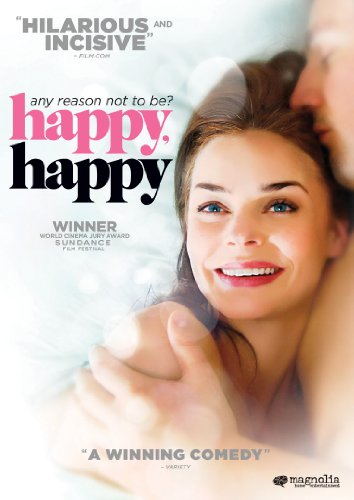
HAPPY, HAPPY Is Mostly Everything But I found HAPPY, HAPPY a bit of a quandary. It’s a film that’s not quite certain what it wants to be, except possibly to be labeled with the adjective “original,” which it isn’t all that much. Someone over at Film.com apparently found it “hilarious and incisive,” which it really wasn’t, either. Parts of the film clearly are intended to be humorous – maybe quirkily charming in some foreign-ish, philandering way – but it’s entire leaps and bounds from either “hilarious” or “incisive.” And someone at Variety apparently dubbed it “a winning comedy” … but winning at what? Drama? Comedy? Melodrama? Contemporary marital horror nightmare? What?At best, HAPPY, HAPPY is a character study in exaggeration, as none of these characters came off feeling all that legitimate to me. According to the film’s press materials: “Family is the most important thing in the world to Kaja” … yet, twenty minutes into the film, Kaja apparently believes performing oral sex on a near-total stranger in the room next to where her husband is waiting for her to come out of the bathroom is ok, so that kinda/sorta negates the whole premise of Kaja finding the concept of “family” all that important. Doesn’t it? Not proof enough for ya? Well, forty minutes into the flick, Kaja is running naked through a frozen Winter countrywide – all hot & bothered from having just given the near-total stranger another bout of oral madness – while her son is walking up the drive. Of course, he sees mommy in the buff, frolicking as she is in the snow with someone who ain’t dear ol’ dad. Welcome to therapy, kid. Yeah, that whole concept of “family” sure ain’t selling this picture!Now, to be fair to the character of Kaja, family really ain’t all that important to her. On that level – family not mattering – almost everything she does makes perfect sense to me, from the risky fellatio to the extramarital sex while her `closeted homo’ husband is parking the car out front. Despite these proclivities – I say “despite these proclivities!” – Agnes Kittelsen imbues Kaja with a kind of small-town charm – the forever mousey girl-next-door – so much that you really can’t dislike her. Maybe you can fault her, but it’s hard to H-A-T-E her. See, Kaja doesn’t find herself all that attractive; yet she has a small frame with delicate features and an infectious smile! For some reason, Kaja believes she’s in a great marriage – with some of its own little shortcomings like a husband who ignores her and a son who treats her poorly – but, thankfully by the film’s conclusion, she’s come to grips with the reality. Her relationship is far from healthy, and it only took behaving like a child to turn her into an adult. While her unfaithful (and gay, don’t forget) husband refuses to leave her, she’ll leave him … even though that essentially means that he’ll be living in the cottage they keep out back.???If you approach HAPPY, HAPPY with a kind of lyrical `Bizarro World’ mentality (up = down; down = up; HAPPY, HAPPY = SAD, SAD), the film makes vastly more sense, though it won’t be for most people’s tastes. It isn’t irony so much as it is a study in opposites: the `perfect couple’ that moves in next door is `far from perfect’ as both of them give in to infidelity before and after we get to know them. It’s this kind of idea – the study of opposites – that serves as a metaphor underlying the entire film. In fact, it gets so obvious that Kaja’s boy (who is white) plays with the perfect couple’s son (who is black while his “visible” parents are white, and it’s never clearly established as to whether or not he’s adopted or whether he’s the result of the wife’s established previous infidelity) … and therein lies the principle problem when you’re dealing with a study of opposites:At which point has the world been set right? Do we know … or will it always be this way?It’s never clear, or perhaps it’s best to conclude that it’s never clearly answered. However, you’ll be glad to know that the `perfect couple’ seemingly reconciles in what appears little more than a cookie-cutter “I miss you” moment that defies the logic (opposites) already established for the picture. (Shouldn’t it have been “I don’t miss you”?) They destroyed one another in their respective journeys to find one another … or some other Hollywoodish nonsense that only appears in movies. At the end, everyone is HAPPY, HAPPY, so that’s all that matters.Also, the film has a disturbing subplot involving the two young boys which revolves around that never-ending source for comedy: slavery. In short, the little white boy gives the little black boy a book depicting the practices of slavery, and the two of them endure several supporting vignettes wandering about the house re-creating various stages of the slave/master relationship. See, that’s all well and good … right up until you see the little white boy whipping the…