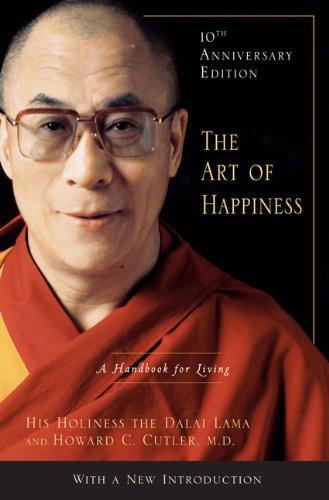

Nearly every time you see him, he’s laughing, or at least smiling. And he makes everyone else around him feel like smiling. He’s the Dalai Lama, the spiritual and temporal leader of Tibet, a Nobel Prize winner, and a hugely sought-after speaker and statesman. Why is he so popular? Even after spending only a few minutes in his presence you can’t help feeling happier.
If you ask him if he’s happy, even though he’s suffered the loss of his country, the Dalai Lama will give you an unconditional yes. What’s more, he’ll tell you that happiness is the purpose of life, and that the very motion of our life is toward happiness. How to get there has always been the question. He’s tried to answer it before, but he’s never had the help of a psychiatrist to get the message across in a context we can easily understand.
The Art of Happiness is the book that started the genre of happiness books, and it remains the cornerstone of the field of positive psychology.
Through conversations, stories, and meditations, the Dalai Lama shows us how to defeat day-to-day anxiety, insecurity, anger, and discouragement. Together with Dr. Howard Cutler, he explores many facets of everyday life, including relationships, loss, and the pursuit of wealth, to illustrate how to ride through life’s obstacles on a deep and abiding source of inner peace. Based on 2,500 years of Buddhist meditations mixed with a healthy dose of common sense, The Art of Happiness is a book that crosses the boundaries of traditions to help readers with difficulties common to all human beings. After being in print for ten years, this book has touched countless lives and uplifted spirits around the world.
At first, the Dalai Lama’s answers seem simplistic, like a surface reading of Robert Fulghum: Ask yourself if you really need something; our enemies can be our teachers; compassion brings peace of mind. Cutler pushes: But some people do seem happy with lots of possessions; but “suffering is life” is so pessimistic; but going to extremes provides the zest in life; but what if I don’t believe in karma? As the Dalai Lama’s responses become more involved, a coherent philosophy takes shape. Cutler then develops the Dalai Lama’s answers in the context of scientific studies and cases from his own practice, substantiating and elaborating on what he finds to be a revolutionary psychology. Like any art, the art of happiness requires study and practice–and the talent for it, the Dalai Lama assures us, is in our nature. –Brian Bruya
The Source of Happiness is Within You I have always had a lot of respect for the Dalai Lama and admired the fact that he radiates so much genuine compassion and tolerance despite the many hardships that he has faced in his lifetime. I believe that this book is the essence of this man’s being and his outlook on life. It encompasses many of his core beliefs and serves as an inspiration to everyone, irrespective of religious affiliation or spiritual belief.This book is not written by the Dalai Lama himself, but by Howard C. Cutler, and is based on his numerous conversations with His Holiness. Dr. Cutler provides the “western”, science-based perspective on the buddhist monk’s teachings. While his naivete gets to be annoying at times, he helps relate the Dalai Lama’s teachings to our everyday lives by making them less abstract, more practical and actionable.”I believe that happiness can be achieved through training the mind… Generally speaking, one begins by identifying those factors which lead to happiness and those factors which lead to suffering. Having done this, one then sets about gradually eliminating those factors which lead to suffering and cultivating those which lead to happiness.” These words contain the essence of the entire book. A premise so elegant and simple that it might be easy to dismiss at first, and yet so powerful. The more one thinks about their true meaning, the more one begins to understand that these words, in themselves, hold the answer to the purpose of our lives.The idea that happiness is the product of our mind, rather than of our objective situation, is hardly new. Yet, this book is able to explore this notion to the depths that I had never comprehended before. In particular, the distinction the Dalai Lama so eloquently makes between happiness and pleasure is especially enlightening. After all, it’s the very things that bring us pleasure, that cause us unhappiness in the long term. Therefore, His Holiness says, one ought to always ask oneself before making a choice: “Will this bring me happiness?” I performed this simple practice for just a few days, and noticed immediate results. While I normally would do certain things without thinking, I have now become quite conscious of the effect that my own actions will have on my life down the road. Even such a simple thing as doing the dishes, or making that unpleasant yet necessary phone call, or buying something that we don’t really need – each one is a choice that, once made, reverberates through our life and either brings us happiness or discontentment. This simple shift in perspective is a very powerful tool in bringing about real, positive change in your life through small, yet deliberate actions. It is by making these actions a habit that one is able to truly achieve happiness.Of course, in order to be able to work towards happiness, one needs to understand what it is that will bring them happiness in their personal life. This can be likened to having a “mission statement” that encompasses many different areas that, when all balanced and fulfilled, lead to a happier life. These ultimate goals, the Dalai Lama teaches, should be used as a compass to align you daily choices with in your pursuit of happiness.In addition to these very powerful meditations on the nature of happiness, the book stresses the importance of “human warmth and compassion” as integral components of achieving happiness through increased intimacy and deeper connection to others. The book also explores the “demons” that often prevent us from finding happiness, such as pain and suffering, anger and hatred, anxiety and low self-esteem. While you may not necessarily be afflicted with all of these “demons”, reading this book will help you avoid them or enable you to help others who are suffering from them.Overall, I would wholeheartedly recommend this book to anyone on a spiritual journey, in search for a meaning of life, or simply looking for simple words of wisdom in our increasingly complicated and materialistic age. This is one book I know I will personally refer back to again and again for inspiration and guidance.
Dalai Lama + Joe Blow = ? The big disappointment here is that there is very little Dalai Lama in this book. It is not the Lama’s handbook for living, it is Howard Cutler’s handbook for getting rich off the Dalai Lama’s good name. Howard Cutler is a professional psychologist, and — one quickly concludes — a rather average one.
Useful concepts In The Art of Happiness The Dalai Lama tells listeners how to defeat day-to-day depression, anxiety, anger, jealousy. The concepts are simple but difficult. If you liked this book I would suggest you also read Way of A Peaceful Warrior and An Encounter With A Prophet