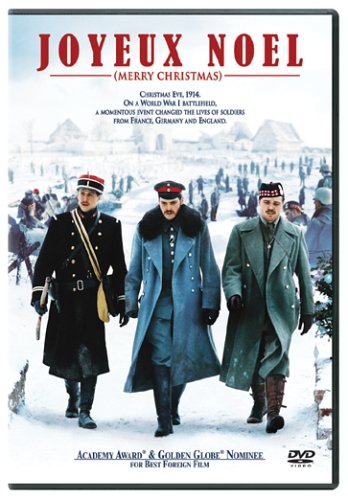

Academy Award, Golden Globe and BAFTA nominee for Best Foreign Film, Joyeux Noel (Merry Christmas) tells the true-life story of the spontaneous Christmas Eve truce declared by Scottish, French and German troops in the trenches of World War I. Enemies leave their weapons behind for one night as they band together in brotherhood and forget about the brutalities of war. Diane Krüger (Troy), Daniel Brühl (Good Bye Lenin!) and Benno Fürmann (The Princess and the Warrior) head a first-rate international cast in a truly powerful, must-see film.Joyeux Noel captures a rare moment of grace from one of the worst wars in the history of mankind, World War I. On Christmas Eve, 1914, as German, French, and Scottish regiments face each other from their respective trenches, a musical call-and-response turns into an impromptu cease-fire, trading chocolates and champagne, playing soccer, and comparing pictures of their wives. But when Christmas ends, the war returns…Joyeux Noel has been justly accused of sentimentality, but if any subject warrants such an earnest and hopeful treatment, it’s the horrors of trench warfare. The largely unknown cast–the more familiar faces include Diane Kruger (Troy), Daniel Bruhl (Good Bye Lenin!), Benno Furmann (The Princess and the Warrior), and Gary Lewis (Billy Elliot)–deliver low-key but effective performances as the movie dwells on the everyday elements of life in the face of war. Based on a true incident (though considerably fictionalized). –Bret Fetzer
Stills from Joyeux Noel (click for larger image)
 |

|
 |

|
 |
 |
Merry Christmas in No Man’s Land: Inspired by an Episode in World War I On Christmas Eve in 1914, the first year of World War I, there was an unauthorized truce between the German and the British/French armies. Both sides first agreed to bury the dead, and a mass was held during this brief time. Some soldiers even enjoyed playing football in no man’s land.`Joyeux Noël’ is inspired by a real-life event that really happened on Christmas Eve at the several front lines during the First World War, and presents the material in a pretty orthodox way, employing the well-handled multi-plot device, in which we will witness the joys and the pains of each character: Guillaume Canet as French lieutenant, Daniel Brühl as German officer, and Gary Lewis as Scottish military chaplain. The cast playing the soldiers are unanimously good, but it is Gary Lewes as tormented military chaplain who is most impressive among them.’Joyeux Noël’ also has a sub-plot about a beautiful soprano singer played by Diane Kruger and tenor singer (and her husband) by Benno Fürmann. I don’t know to what extent the film generalized these historical events it shows, but I think their love story looks less effective before the more realistic episodes about the solider in trench. Still these songs are beautiful, and so is Diane Kruger (whose voice is dubbed by soprano singer Natalie Dessay), showing the power of the music which is timeless and universal.But to some viewers (including me), smaller things would remain more strongly in their mind. A stray cat found in trench is given different names by the German and the French soldiers. There is a good-natured French soldier Ponchel, who sneaks out of the trench every night to meet his family living behind the enemy line. There are moments when the film wears its heart on its sleeve, but it is most touching when it chooses not to be so, showing the details of the life under the extreme circumstances.In spite of its wave of sentimentality, `Joyeux Noël’ does not forget the reality surrounding the soldiers. It surely has some “feel-good” moments that are often seen in the films about Christmas, but it is also about the humans on the battlefield, and you will realize it when you know the fate awaiting them. After all, it was still 1914, and most people must have thought the war would be over soon while we know it finally ended in 1918. The film has a clear, life-affirming message bolstered by moving songs, but the film may look slightly poignant when you imagine how many of them could have survived the war. `Joyeux Noël’ is an inspirational French film with several touching songs, a bit of sadness, and hope, too.
“It came upon the midnight clear that glorious song of old,from angels bending near the earthto touch their harps of gold.”Peace on earth, good will to men,from heaven’s gracious King.The world in solemn stillness layto hear the angels sing.”On December 24, 1914 a spontaneous, unscheduled, unapproved truce among German, French and British soldiers took hold in various sectors along the front lines. Soldiers exchanged cigarettes and alcohol, played football (soccer), and allowed the removal and burial of dead soldiers from the frozen tundra of no mans land. “Joyeux Noel”, a French-made film with an international cast directed by Christian Carion, is a fictionalized account of this truce. It is a wonderful film that in its own way stands with or close Stanley Kubrick’s “Paths of Glory” as one of the great films about the horrors of what has come to be known as the First World War.The film opens in the days and years before the start of the “Great War”. We see British (in this instance Scottish), French, and German schoolchildren absorbing lessons in Kiplingesque nationalism and empire-building that taught each group that God was on their side and demonized the evil German, Briton, or French. After a quick introduction to the main characters the war begins in all its brutality. The Scottish and French troops rise up from their trenches and are mowed down by German machine-gunners. The dead and wounded are left in no-mans land. At the same time we see the respective high commands, enjoying the comfort of life war out of harms way. As night falls on Christmas Eve, German soldiers place small Christmas trees atop their trenches. A bagpiper plays a Christmas tune and the German soldiers applaud. A German enlisted man, a well-known singer (the relationship between the soldier and his Danish wife, also a singer form the basis of much of the plot) rises out of the trenches to sing Silent Night.”Still through the cloven skies they comewith peaceful wings unfurled,and still their heavenly music floatso’er all the weary world;above its sad and lowly plainsthey bend on hovering wing,and ever o’er its Babel-soundsthe blessed angels sing.”It is said that music hath charms to sooth the savage heart and in short order the German, French, and Scottish squad leaders (the “Three Wise Men”?) meet to discuss a short truce. The truce takes on a life of its own and forms the centerpiece of the rest of the film. The interaction amongst the soldiers is well crafted and well acted. There are even light moments as a stray dog routinely crosses the field of battle to take food from whatever army wishes to feed it. The cinema photography is lush without detracting from the story line. The songs sung by the soldiers as they observe the holiday truce are compelling. In the context of a war, even during a truce, the words to hymns of peace are tragically ironic. The words of peace must have been comforting but it is a comfort born of stolen moments and director Carion does an excellent job conveying the all too temporary nature of this reprieve.”Yet with the woes of sin and strifethe world has suffered long;beneath the heavenly hymn have rolledtwo thousand years of wrong;and warring humankind hears notthe tidings which they bring;O hush the noise and cease your strifeand hear the angels sing!”The film shows us the aftermath of the truce, the reaction of the high commands and it is these moments that bring Paths of Glory to mind.Joyeux Noel is a beautifully drawn and acted film that very much deserved (and perhaps should have won) its Oscar, Golden Globe, and BAFTA nominations. Highly recommended. L. Fleisig
Worth Weighing With our country at war and Christmas coming up, this seemed like a timely movie to share with my family. I’d heard it was based on actual events from World War I, a Christmas Eve on which three sides of the war in the trenches laid down their weapons to share in an evening of peace.”Joyeux Noel” is not only beautifully directed and photographed, it uses a cast of great actors. The story revolves around a Scottish priest caught up in the drama, two German opera singers caught between love and patriotism, and a French lieutenant missing his pregnant, sick wife. Other characters are included as the movie meanders toward the momentous evening on December 24, 1914. For American audiences raised on constant drama, this might seem to lack fireworks; yet the ideas here are potent, made all the more so by their basis in fact. When one man makes a simple sacrifice for the sake of his superior, he pays a price that underlines the irony of war.In conclusion, the movie is a moving tribute to men of three nations who saw past hate and political intrigue long enough to share in their humanity. The true enemies reveal themselves as those who stick dogmatically to their own agendas. This is a message worth weighing–spiritually and politically–in light of our current Christmas situation.