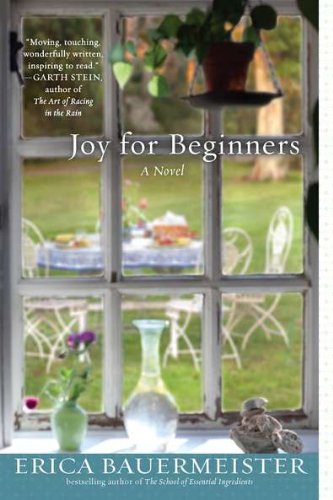

What would you do with a second chance at life?
Having survived a life-threatening illness, Kate celebrates by gathering with six close friends. At an intimate outdoor dinner on a warm September evening, the women challenge Kate to start her new lease on life by going white-water rafting down the Grand Canyon with her daughter. But Kate is reluctant to take the risk.
That is, until her friend Marion proposes a pact: if Kate will face the rapids, each woman will do one thing in the next year that scares her. Kate agrees, with one provision – she didn’t get to choose her challenge, so she gets to choose theirs. Whether it’s learning to let go of the past or getting a tattoo, each woman’s story interweaves with the others, forming a seamless portrait of the power of female friendships. From the author of The School of Essential Ingredients comes a beautifully crafted novel about daring to experience true joy, starting one small step at a time.
“Moving, touching, wonderfully written, inspiring to read.” -Garth Stein, author of The Art of Racing in the Rain
At an intimate, festive dinner party in Seattle, six women gather to celebrate their friend Kate’s recovery from cancer. Wineglass in hand, Kate strikes a bargain with them. To celebrate her new lease on life, she’ll do the one thing that’s always terrified her: white-water rafting. But if she goes, all of them will also do something they always swore they’d never do-and Kate is going to choose their adventures.
Shimmering with warmth, wit, and insight, Joy for Beginners is a celebration of life: unexpected, lyrical, and deeply satisfying.

Q: What compelled you to write Joy for Beginners?
A: A few years ago, my sister-in-law, who has been part of a band for years, told me that she was going to celebrate her 50th birthday by singing her first solo concert. There was something so bold and liberating in her declaration, especially as it came from someone who is actually quite shy. I loved the audacity of it, the courage behind it, and it gave me the idea for a book. In the end, a group of seven women characters showed up in my imagination, ranging in age and personality and facing an equally eclectic group of challenges, but that first idea of reaching beyond what is comfortable remained the same.
Q: When you gave readings from your previous book, The School of Essential Ingredients, you sometimes mentioned the idea for this new novel, and received a strong reaction from the women in your audiences. What did they say?
A: I think many of us want to stretch ourselves—try something new, face a fear, break out of a role or a rut we have fallen into. Sometimes we just need an excuse (or a good, firm shove) to get ourselves to do it. I see Joy for Beginners providing that inspiration, by showing readers ordinary, complicated people pushing themselves into new and different territories. I’ve talked with several book clubs that have decided to read the book and do their own set of challenges at the same time, and I think that’s a wonderful idea.
Q: The mysterious power of food to heal and to bring people back to their essential selves was a central theme of your first book. Your new book is not focused on food, yet you see a strong connection between the two books. What is it?
A: As with The School of Essential Ingredients—where the focus was food but the point was all the emotional and mental revelations that occurred before, during and because of cooking—the emotional center of Joy for Beginners lies in what the women learn through their challenges, even more than the challenges themselves. As a result, the challenges range from the overtly and physically demanding to ones that might seem simple on the surface. As I was writing, I was thinking—what are we truly afraid of? For some, it might mean climbing a mountain or sky diving, but my guess is that for many people fear is often contained within something far less obvious. As Eudora Welty said: “all serious daring starts from within.”
Q: Your books are in many ways a celebration of the senses. Why is there such a strong emphasis on the senses in your work?
A: I think our senses are one of the greatest gifts we have been given, and that our lives only become richer by paying attention to them. Most of us spend so much of our days facing a screen – computer, phone or television. What a delight to remember that we live in bodies with fingers that touch and tongues that taste and noses that have the power to take us, with one inhalation, back in time or into the presence of someone we once loved.
Q: Which of your characters are you most like?
A: I get asked that question a lot. The truth, as I think is the same for many authors, is that they are all me and none of them are me. I made a promise to myself a long time ago that I wouldn’t write any character that I couldn’t feel empathy with—which meant I had to get into their heads and understand how they thought. What surprised me was that it was often the characters that were least like me who really surprised me into empathy.
Photo of Erica Bauermeister © Susan Doupe
4.5 stars — lyrical lovely just-right prose Kate challenges a group of her friends to pursue their own joy in ways that each of them need.The women are a loosely connected group who were first put together by Marion to be a “baby-holding” help to help Sara out with her newborn twins (and preschooler son). When Kate was diagnosed with breast cancer, Marion thought it only made sense for the group to morph from helping out Sara to being there for Kate, a divorced empty-nester, in her time of need.When Kate beat breast cancer, she did something that she never thought she would. She agreed to accompany her adult daughter on a raft trip through the Grand Canyon. She figured that she had cheated death once — why not expand her boundaries while pushing her luck a second time? At her celebration dinner, Marion thinks that each of them should make a pact to do something that is “scary or difficult or that we’ve always said we were going to do but haven’t” (ARC page 8). Kate thought it was a great idea but added “I didn’t get to choose mine, so I get to choose yours.”These women were all so different, and so readers will each relate to a different woman’s struggles, which would probably make for a good book club chat.I loved each of them in different ways: *Hadley, a young widow, trying to push through her grief and figure out life on her own *Caroline, bookstore owner (love her already!)recovering from a divorce and navigating life as an empty-nester *Marion, the glue of the group, who needs to be pushed to do something just for her *Daria, Marion’s younger sister, an independent, artistic, free-spirit *Sara, a good mom, wrapped up in the needs of her family, who is challenged to forget all of them for a while *Ava, a friend of Kate’s who couldn’t be there for Kate during her illness and feels like she’s being punished *and Kate, the survivor, brave but not maudlinThis book reminded me a great deal of Erica Bauermeister’s first novel The School of Essential Ingredients. The characters and the plot are entirely different, but the beautiful, lyrical language that jumps off the page is the same, and each book looks at a loosely connected group of people, and devotes a section to each character.
Comfort Stories “Tell me, what is it you plan to do with your one wild and precious life?” — Mary OliverThat question from the epigraph is pertinent to Kate, who was hit hard by breast cancer and, now recovered, is reluctant to accept her daughter’s celebratory challenge to go white-water rafting. But it’s also pertinent to Kate’s circle of close friends, who support her by agreeing that she also issue a challenge to each of them — something that will ease a fear and increase the joy and living in their own lives.I loved Bauermeister’s debut novel (, a collection of linked stories about the students in a series of cooking classes) and remember ending my review by wishing I could read another set of stories about the next year’s class. Happily, JOY FOR BEGINNERS is nearly that, with writing as sensual and lush and stories as tender and hopeful. But here they’re even sweeter, gentle to the point of lacking narrative tension, and they lack SCHOOL’s sympathetic lead character and unifying story premise. Recommended for readers in the mood for comforting stories about women’s friendships.