
0
0
0
0
0
0
0
0
0
or copy the link
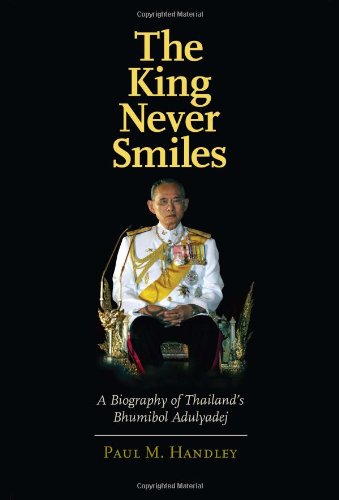
Thailand’s Bhumibol Adulyadej, the only king ever born in the United States, came to the throne of his country in 1946 and is now the world’s longest-serving monarch. The King Never Smiles, the first independent biography of Thailand’s monarch, tells the unexpected story of Bhumibol’s life and sixty-year rulehow a Western-raised boy came to be seen by his people as a living Buddha, and how a king widely seen as beneficent and apolitical could in fact be so deeply political and autocratic.
Paul Handley provides an extensively researched, factual account of the king’s youth and personal development, ascent to the throne, skillful political maneuverings, and attempt to shape Thailand as a Buddhist kingdom. Handley takes full note of Bhumibol’s achievements in art, in sports and jazz, and he credits the king’s lifelong dedication to rural development and the livelihoods of his poorest subjects. But, looking beyond the widely accepted image of the king as egalitarian and virtuous, Handley portrays an anti-democratic monarch who, together with allies in big business and the corrupt Thai military, has protected a centuries-old, barely modified feudal dynasty.
When at nineteen Bhumibol assumed the throne, the Thai monarchy had been stripped of power and prestige. Over the ensuing decades, Bhumibol became the paramount political actor in the kingdom, silencing critics while winning the hearts and minds of his people. The book details this process and depicts Thailand’s unique constitutional monarchhis life, his thinking, and his ruling philosophy.
Paul Handley provides an extensively researched, factual account of the king’s youth and personal development, ascent to the throne, skillful political maneuverings, and attempt to shape Thailand as a Buddhist kingdom. Handley takes full note of Bhumibol’s achievements in art, in sports and jazz, and he credits the king’s lifelong dedication to rural development and the livelihoods of his poorest subjects. But, looking beyond the widely accepted image of the king as egalitarian and virtuous, Handley portrays an anti-democratic monarch who, together with allies in big business and the corrupt Thai military, has protected a centuries-old, barely modified feudal dynasty.
When at nineteen Bhumibol assumed the throne, the Thai monarchy had been stripped of power and prestige. Over the ensuing decades, Bhumibol became the paramount political actor in the kingdom, silencing critics while winning the hearts and minds of his people. The book details this process and depicts Thailand’s unique constitutional monarchhis life, his thinking, and his ruling philosophy.
New Perspective As someone who spent my childhood in upcountry Thailand, went to state schools there and later in Bangkok and had an advance degree from a US University, I thought i would share with my countrymen how we perceive the King. My conversations with friends, colleagues, and most of the comments here by Thai readers/reviewers say I was totally wrong.The book hits the nail in its head when it says that most thai my generation (I was born in the turbulent year 1976, when the right-wing government crushed student protestors and the King declared the event “the saddest day in Thai history”) have always seen the King in the best of lights – and it was not something that wasn’t well-planned by someone. In retrospect, I agree with the author about how the palace has orchestrated all their efforts on setting the royals in the best of lights, i.e. making all the royal projects look far more important and successful than their real worths by downplaying efforts by governments, presenting the royals in the way of super-human, in every aspect possible. When I was a young adult, I did not have a second thought about what the media was protraying the king and the royal family, i accepted it as truths and I don’t have any reason to believe that most of my countrymen would see things otherwise – everything was so grand, so well orchestrated and thus so believeable.One notable point that I think Handley sums up the sentiment of many Thai very nicely is when he briefly discussed another biography on King Bhumibol “The Revolutionary King” (which I also read several years back) that it was probably for the consumption of a small group of educated Thais who tend to be more ready to accept what’s written in English than those written in Thai (for several reasons, for one, they believe the author can escape the lesse majeste by saying negative things about the King in English) My view about the King has always been similar to the one protrayed in “The Revolutionary King”, which puts the King as a very capable person though with some minor flaws – which make it easier to swallow than “The Perfect One” image that the Palace media has always been projecting. Deep down, I believe, many Thais think of the King as human, yet a very respectable one (though many choose to live with the fairy tale that he is a true semi-god), so when we hear negative minor points about him, we think it could all be possible and make him even more humane yet more likable. This could be the original purpose of the “Revolutionary King” – reinforcing the King’s image to the elite Thai lot. The book was written by the person who wrote “The Man called Intreprid” which was translated by the King himself.Overall, Handley convincingly argue his case that things could be looked at in a very different perspective. He backs up his arguements with well-researched evidence many anecdotes the average Thai would have heard of. For me I haven’t heard of just about half (probably more for even younger people), the others are totally new to me.This book is recommended to any Thai who wants to understand the country and the monarchy better, in a more objective way. This book doesn’t make me love the country and the King less. It makes me understand the King better on a more realistic term.For a book of 500 pages and for a non-native speaker, I finished it in only three sittings and couldn’t put it down. I give it a 4-star.I also recommend an academic piece by McCargo “Network Monarchy” if you find this book interesting.
A Veil Has Been Lifted As an American born in Thailand in 1949, and having lived there until 1975, I enjoyed having the dim memories of this period of my life brought to full clarity. I was surprised that given my youth that I would remember all the Thai names. The description of the competition between the civilian government and the monarchy to improve the lot of the Thai people brought back a memory when I was only five or six; I was sitting on the lap of Prime Minister Phibunsongkhram at a ribbon cutting ceremony of a agricultural research station in Khon Kaen in the impoversihed Northeast (Pak Isan), where I lived most of my early years. I remember when Prime Minister Sarit imposed price controls on food when one of his many wives complained about the prices. He also had bus drivers shot when caught racing their buses; which cut down on the number of accidents. I grew up with an appreciation for benevolent dictators; and even today believe that the goal of the neocons to spread democracy to all countries is naieve. I also remember hearing many rumors about the royal family which I never thought would be revealed; so reading this book helped to put the puzzle together, and has brought my knowledge up to date for events that have happened since 1975. My respect for the King has not diminshed from these revelations. Indeed, I have a greater respect for the King having read the book; as it reveals a strategy that through moral leadership, he could restore the monarchy to such as elevated position in Thai politics that he could work behind the scenes to bring down both military or civilian governments when their level of corruption hurt the Thai people. When news came out about the recent coup, I understood completely. I also give the King all the credit for keeping Thailand from becoming the next domino to fall after Vietnam, Cambodia, and Laos. He was able to achieve his goals by ensuring that the monarchy was shrouded in mistique which hid his blemishes as no one is perfect; certainly something that the British monarchy or any democratic government is unable to achieve with our open press. I agree with the author that his greatest failing may be the lack of preparation of his successor. In conclusion, I was delighted to have this portrait painted for me. I have recommended the book to my Thai friends living here in the U.S.; recognizing that they would not be able to find this book in Thailand, which is too bad. Anyone who wants to know about the role of the royal family in Thai politics and culture must read this book.
Isn’t This the Customer Review of the Book Section? The first official printing of this book just came out this past week. Respectfully, has anyone of the previous reviewers read the book? If not, please do so and come back to give a fair review of it (if you really care about the subject enough) and stop sounding ridiculous.This is a section for potential buyers who seek your thoughts about the book so that they may decide whether or not they should buy it, not about what you think about the King before reading it. There are online forums for you to post your personal comments without having to read this rather thick book. If you know how to use internet, you can find those online forums, too.(What’s funny is that some people found these reviews of the book helpful when the reviewers hadn’t even read the book.)The first reviewer (bottom one) might have read the review copy before it was officially printed since s/he posted his review in mid-February. S/he gave a pretty fair assessment of the book. One correction though, the King was never an Olympic medalist. He won a gold medal from the Southeast Asian Games (SEAGAMES).I agree with him/her about the early reign portion of the book. The first 100+ pages was well researched with only a few controversies that actually sound hearsay added. They sound hearsay because the lack of concrete proves or sources. Most of these controversies are nothing you can’t find on the internet websites with the right keywords on simple Google searches or wikipedia. It also helps if you know how to read Thai to read this book.The reason the later parts of the book sound spiteful might be due to the fact that his former work (Far Eastern Economic Reviews, a magazine based in Hong Kong) was banned in Thailand because two of his former close colleagues wrote an article that was considered a threat to the Thai national security and were deported. If you want to know more about this issue just Google search with keywords like Far Eastern Economic Reviews + Thailand. Then try searching the author’s name together with the people deported. It’s all there for you to read and learn for free.The Index section in the back of the book is better than good. It is very well organized. However, I have a little problem with the Sources section. Paul Handley inserted many of his own rather lengthy hearsay personal opinions in the same section of the book. It just makes it seem like there are so many credible sources that he cited from to write this book when most of them are old Thai newspapers that reported in English (wouldn’t you think that if they are Thai newspapers, they would have been subjected to censorship during that time also? Then what is so secretive about stories from his sources?).Furthermore, you will see lots of those “Ibid” in that section following the newspaper’s names. Other sources are Thai memoirs, popular magazines like the Times, and funeral pamphlets of celebrities. I wonder how he was able to read accurately those memoirs and pamphlet that were written in old Thai language.One other little things that made me think about the accuracy of what I was reading is the fact that he sometimes refer to the people he talks about in the book with only half of their first names or titles. Handley says in the beginning of the book about how Thai names and positions are long and hard to spell and even go out to say that he has tried his best, but I’m talking about the equivalence of referring to Barbara Bush as “Barb” and Hillary Clinton as “Hilla”. It’s just weird for reading this kind of book and that happens. If you don’t know a little bit before hand about some of the people he’s talking about, it can be very difficult to find out who it is that he’s actually talking about.I lived in Thailand 17 years and able to read and speak Thai fluently. I tried my best to be open-minded and logical when I was reading this book as I, too, wanted to learn as much as possible about the facts of this subject matter. My conclusion for you who’s reading this line is, most of you will put it down before finishing the first 50 pages due to spelling of Thai names and religious terminology. If you can swallow that, you will enjoy reading the rest of the book.However, I seriously question the claim that this book is well-researched independent work. The writing about controversies that Handley tries to add into his book to make this sounds like an independent research is nothing new to me. They can be found easily online with the right keywords. I have in my possession many Thai books that he refers to, and even with those, he didn’t provide enough to conclude anything.The King’s family issues are also nothing new to me. I believe most Thai people know about them, too. It’s not that the truth are always kept away from them. They just don’t like talking about those issues out of respect for the King as they are his…