
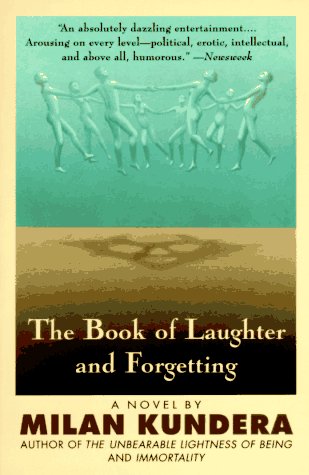
A vivid mix of fictional autobiography and myth examines the human condition through five uniquely integrated parts, humorously and movingly depicting the political, erotic, and intellectual facets of modern life. Reissue. NYT. In one of the finer modern ironies of the life-imitates-art sort, the country that Kundera seemed to be writing about when he talked about Czechoslovakia is, thanks to the latest political redefinitions, no longer precisely there. This kind of disappearance and reappearance is, partly, what Kundera explores in The Book of Laughter and Forgetting. In this polymorphous work — now a novel, now autobiography, now a philosophical treatise — Kundera discusses life, music, sex, philosophy, literature and politics in ways that are rarely politically correct, never classifiable but always original, entertaining and definitely brilliant.
The Book of Laughter and Forgetting
Pinned on October 26, 2013 at 12:49 am by Todd Stephens
0
0
0
0
0
0
0
0
0
or copy the link
Comments
Astonishingly Wonderful; A Must-Read THE BOOK OF LAUGHTER AND FORGETTING is a rare and precious jewel. In many ways this is an experimental novel, the seven different parts of the book are compared by the author to Beethoven’s variations upon a musical theme. These different variations either describe, converge upon, or dance around the story of Tamina, a Czech exile who ran away from the communists with her husband only to see him die of disease soon afterward. As time passes she becomes obsessed with the mortal fear that she will forget him. She cannot go back to her homeland but she can try to get her husband’s love letters back, to bring some of his laughter back into her life, to remind her that she is not alone.
Beautiful philosophical – historical – sexual meditation Like Rushdie’s Satanic Verses, this book is largely about angels and devils, or good and evil. The setting is (mostly) Prague around 1970, and the basic political themes — Czech and Russian Communists and their adversaries — are used as a foundation for the more ethereal, philosophical themes, such as the nature of humor, the nature of history, and the differences between the genders.