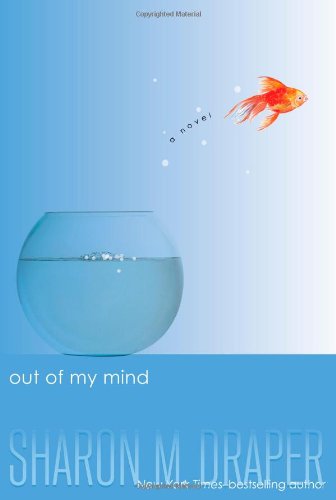

FOR USE IN SCHOOLS AND LIBRARIES ONLY. Possessing a photographic memory in spite of an inability to walk or speak, Melody is mistaken as mentally challenged by those who cannot see beyond her cerebral palsy. Eleven-year-old Melody has a photographic memory. Her head is like a video camera that is always recording. Always. And there’s no delete button. She’s the smartest kid in her whole school—but no one knows it. Most people–her teachers and doctors included–don’t think she’s capable of learning, and up until recently her school days consisted of listening to the same preschool-level alphabet lessons again and again and again. If only she could speak up, if only she could tell people what she thinks and knows . . . but she can’t, because Melody can’t talk. She can’t walk. She can’t write.
Being stuck inside her head is making Melody go out of her mind–that is, until she discovers something that will allow her to speak for the first time ever. At last Melody has a voice . . . but not everyone around her is ready to hear it.
From multiple Coretta Scott King Award winner Sharon M. Draper comes a story full of heartache and hope. Get ready to meet a girl whose voice you’ll never, ever forget.
A Note to Readers from Author Sharon Draper

People often ask me, “What was your inspiration for Out of my Mind?” I reply, “All great stories emerge from deep truths that rest within us.” But the real truth of a story often can be found in places that not even the author has dared to explore. I suppose the character of Melody came from my experiences in raising a child with developmental difficulties. But Melody is not my daughter. Melody is pure fiction–a unique little girl who has come into being from a mixture of love and understanding. Out of my Mind is the story of a ten-year-old-girl who cannot walk or talk. She has spirit, determination, intelligence and wit, and no one knows it. But from buildings that are not wheelchair–accessible to classmates who make fun of her she finds a strength within herself she never knew existed.
I was fiercely adamant that nobody feel sorry for Melody. I wanted her to be accepted as a character and as a person, not as a representative for people with disabilities. Melody is a tribute to all the parents of disabled kids who struggle, to all those children who are misunderstood, to all those caregivers who help every step of the way. It’s also written for people who look away, who pretend they don’t see, or who don’t know what to say when they encounter someone who faces life with obvious differences. Just smile and say hello!
–Sharon M. Draper
Helped me see my daughter with new eyes A few weeks ago, Kelly wasn’t feeling well so I took off work to fill in for her at the kids’ Valentine’s Day parties at school. First I went to Chloe’s second grade class. Chloe is non-verbal and has some physical limitations and development delays due to an unidentified genetic disorder. Prior to this year, she has been in special ed classes, with part of her day spent in regular ed classes. Now she is in a regular ed class all day with a full-time assistant and is the only child in her class with special needs.As I sat and watched her interact with the other kids at her table, the other kids’ interactions with her impressed me. Without fail, they were sweet, helpful, friendly, and even conversational. Chloe will nod in response, but does not speak, and does not make a lot of eye contact. Yet these kids spoke and interacted with her as if nothing was different about her. One of the little girls asked me if I was Chloe’s daddy. I told her I was. She said, “Chloe and I are best friends!” I’m telling you I almost lost it there; I had to exercise lots of self-restraint not to cry in front of her. I loved seeing Chloe, who is content to play alone in her room for hours on end, in this setting, with such great support from her peers.Then I went to help set up for Elliot’s 6th grade party and was intercepted by one of his teachers. Almost breathlessly, she said, “I read a book you have to read. It’s called Out of My Mind, and I thought of Chloe the whole time I was reading it!” She had told Elliot the same thing, so he read it and told Kelly about it so she read it, and since they liked it so much, I picked it up yesterday. I hardly put it down and finished it in a day.Not only did I think of Chloe as I read, but I thought of Kelly, me, and Chloe’s teachers and assistants. In Out of My Mind, Melody, the 11-year-old protagonist, has cerebral palsy. Though confined to a wheelchair and unable to speak, her mind is active, brilliant, and and capable of remembering anything she reads, sees, or hears. Much of her school years have been spent in boring, humiliating special ed classes. When she can read thousands of words, of course she gets upset when the teacher is teaching the alphabet. Finally, through her own initiative and the persistence of her assistant and her family, she gets an assistive communication device, giving her a voice for the first time in her life. Finally she can communicate verbally and participate more in school, even helping the school’s quiz team qualify for the national finals.Throughout the story, my heart broke for this precious girl, bringing me to tears on several occasions. How frustrating not to be able to makes oneself understood. How isolating not to be able to interact with people around you. I, of course, kept thinking of Chloe, my smart little girl who has such a hard time communicating. I don’t know that she has a photographic memory like Melody, but I know she’s always been smarter than we know. What’s going on in her mind that we can’t see or hear? How many inane, boring lessons has she sat through, thinking “I know all this! Stop with the baby lessons!” And when Chloe watches the other kids run and talk and laugh and play, does she long, like Melody, to be a part? Does Chloe get embarrassed by her difficulty in feeding herself, that she wears diapers at age 9, that she rides the handicapped bus?I thought of Kelly as much as I thought of Chloe. Melody is a lucky girl in that her mom never gives up believing in her. She has to come to bat for Melody time and again, sometimes in a militant way. In the same way, Kelly has been Chloe’s biggest advocate, her momma bear instincts pushing and pushing to make sure Chloe gets services she needs and is in the best placement for her growth. And the link between Melody and her mom could just as well describe Chloe and Kelly. Kelly knows what Chloe’s every little gesture means, and usually knows what Chloe’s thinking. She can tell by looks if Chloe feels bad, and can smell when she’s thirsty. Weird. Melody’s dad plays a smaller role, like me; he’s not as clued in to his daughter as the mom, but does all he can do to help.Draper is a long-time teacher–honored as National Teacher of the Year in 1997–and the parent of a child with “developmental difficulties” (her description) so it’s no surprise that her classroom scenes and dispatches from the special ed classroom seem so real. And her appreciation for the special ed assistants should be noted; I agree with Draper–those folks do wonderful work for way too little money. I for one am so thankful for the faithful ladies who have fed Chloe, changed her diapers, and invested in her learning and development during her school years.Out of My Mind gives the reader a believable window into the mind of a disabled individual. But Draper’s real target audience is the rest of…
A Must Read!!! Melody is trapped in her own body. Born with cerebral palsey, she is unable to perform most of the basic physical functions that the rest of us take for granted. But her mind is completely normal – actually, it’s significantly above normal. However, almost no one realizes that she has any intellectual capabilities. She attends school as part of the special education program, being partially integrated into the regular classroom, where kids are outright mean or awkwardly nice. When she gets a device that enables her to “speak” for the first time in her 11 years, people are shocked that she is like anyone else. And not ready to accept it.Melody is a delightful, observant girl. Her physical challenges and pure intellect enhance her other senses – she sees, smells, and hears things that the rest of us don’t notice. She also has a real gift for reading people, enhanced unfortunately by people’s negative interactions with her. She finds enjoyment in life but also is, understandably, incredibly frustrated. I can almost physically feel Melody’s frustration, her “tornadoes”, with her. The difficulties of not being able to express yourself are unimaginable.I think every child should read this book. Preferably with a parent or teacher to discuss as the book goes along. Draper does not sugarcoat Melody’s life. She is blessed with parents, a neighbor, and some teachers who love her dearly, understand her, and fight for her. Her mother is a true hero. But she also experiences hate and ignorance that no child should have to go through – from other kids, from doctors, and from teachers. The story is often heartbreaking as Melody is let down repeatedly. But her innate sense of self and her loving family also keeps her strong.This book changed the way I think of disabled children (forgive me if I don’t use the most politically correct terms; I’m trying the best I can). We get to know Melody and her classmates, who have Down’s Syndome, autism, and other physical and mental disabilities, as people, not just as labels. We realize how they sad and frustrated they get at cruelty and inadequate education. We see their joy when they have fun and are accepted. In my head I know that differently-abled children have emotions just like everyone else, but it’s so much more powerful when reading Draper’s book. I really feel what they’re feeling. It makes me want to get involved in the special education system, to advocate for disabled children, and to just be a kinder person. I hope everyone will feel this way as they read this book.