Not for Everyone, But a Very Intelligent, Thought-Provoking Movie If you read film reviews frequently you will occasionally come across the phrase, “this movie indicts the viewer.” Never has this phrase been more appropriate than with Michael Haneke’s “Funny Games,” an Americanized remake of his 1997 film of the same name. Unlike the majority of people who will see this movie, I have not (yet) seen the original and knew little about either version before watching this. I didn’t know what to expect when the movie began and, now that it’s ended, I don’t know what to think.The basic summary one can give for this film feels simple enough; a nice suburban family consisting of George (Tim Roth), Ann (Naomi Watts), and their young son Georgie are vacationing at their semi-secluded lake house. Minutes after arriving, two young men appear at their house. Soon, they are being held hostage by the two men and are forced to play a series of little games all revolving around a little bet. The two men bet that the family will be dead by 9 a.m. the next morning and the family bets they’ll be alive.Well…something like that. The set-up appears to be just your average set-up for a hostage/slasher movie. But that’s not what this film is at all. If you’re looking for a horror film or a psychological thriller, start looking elsewhere. “Funny Games” is an indictment of moviegoers who are so accustomed to seeing on-screen violence we’re desensitized to everything.Here is a film where we have two, clean-cut, innocent looking men who just happen to be killers. They have no motive or explanation for what they’re doing. We have a typical suburban family who have no idea what’s going on and react appropriately and realistically to the situations they’re thrown into.The film absolutely defies convention in every aspect. Not a single thing that occurs in this film is predictable, there’s not a single cheap thrill here, and it’s really just a brilliant piece of filmmaking. For a critique on the apathetic quality moviegoers have to violence against innocent people, it’s brilliant how Haneke allows a film that could have been very violent and gory to have little on-screen violence. To further the indictment of the audience, Michael Pitt’s character will talk directly to the camera, making the audience a part of what is going on.In the hands of a different writer/director this could’ve become an annoying plot device. Enough about that though, let’s discuss one of the most pivotal aspects of the film; the acting.Watts and Roth are so believable, you do empathize with their characters….These are the kinds of performances where they completely embody who they’re playing rather than just playing a character. Pitt and Brady Corbet as the psychotic duo are quietly blood-chilling and wholly believable.I’m guessing Haneke’s goal with his Americanized version is just to present the film to a broader audience but whatever the goal…”Funny Games” is a film that deserves to be viewed, thought about, and discussed. It’s not very entertaining, nor is it meant to be, and it’s not very satisfying either (once again though, it wasn’t meant to be). It’s definitely a thinking person’s movie, but it’s an important film. See it.GRADE: B+
If you hated this movie… CONGRATULATIONS! That was the point.Funny Games, if you’ve never seen this the first thing you probably noticed about it was the overwhelming amount of negative reviews which is why I would say Funny Games is less a movie and more of an experience to torture the audience as much as the victims are tortured. An upper class family are terrorized by two psychopaths in their summer villa. That’s the story, but it’s not what the story is, it’s how it’s told.I’ve condemned other movies for being manipulative and exploitative, such as The Woman or We Need to Talk About Kevin. Funny Games is also manipulative and exploitative, however it doesn’t use those tactics simply for plot convenience but to tell you a tired and true message in the most visceral way possible, while The Woman used cheap manipulation to make you hate white men and We Need to Talk About Kevin used piss-poor parenting to make Kevin look like an evil mega-genius.A reviewer on here noted that people who liked Hostel and Saw will probably enjoy this film, but I’d say it’s quite the contrary. Those movies use a slap-dash mystery plot, extreme violence/gore, and some sort of resolution at the end, all the while entertaining you with the over-the-top deaths. Funny Games has no violence, almost no plot, and no resolution, it’s all just sick mind games; and the reason it’s so effective is because it sets up age-old slasher tactics to make the audience cheer for the family while booing and hissing at the bad guys. Instead of getting a nice happy resolution with maybe a few unimportant side-characters getting picked off in the process, Haneke makes you endure each agonizing second of the humiliation and torture and then gives you no pay-off, effectively s***ting on typical expectations. Then there’s the infamous ‘remote control’ scene, where one of the bad guys gets shot then the other rewinds back far enough to save his buddies life and thwart (yet again) the families’ retaliation, you wanted to see a family getting tortured? That’s exactly what you’re getting.I’ve spent quite some time mulling this movie over, why I thought it was effective, what makes it a different type of manipulation, etc, and this movie still baffles angers and confuses me. As a film-lover that is a great thing, a movie made purely for you to hate and condemn, and if you’re looking to be entertained you definately picked the wrong movie, but if you’re looking for a brutal and sadistic experience (and I believe more people are then they would care to admit) and can look past what this movie is but what this movie evokes in people, than you can admire Funny Games for doing what it sets out to do without pulling any punches.So next time you look at that low score, just consider what MIchael Haneke once said “If the film is a success, it will be because audiences misunderstood the meaning behind it”.
Soul Destroying Quite literally. As a technical exercise in film making this is impressive and clever. As a ‘moral lecture’ it is execrable. We witness a family, including their child, being tormented, humiliated, tortured and murdered by two psycopaths. It is truly shocking and offensive, so yes, job done. The target audience may be the people who ‘enjoy’ the ‘Hostel’ and ‘Saw’ franchises, but are they going to (a) see the irony, or (b) care about it if they do? Haneke subverts conventional narrative and plot, puts our demons up on the screen, has them run riot and emerge triumphant. This is a technically accomplished exercise in egregious sadistic nihilism masquerading as an indictment of other, less cold blooded, examples of the genre. No story is played out. There is no hope, no help, no catharsis, no justice and no judgements are made. The viewers deep need to protect and avenge the family is provoked, toyed with (one of the ‘Funny Games’) and denied. This is one of the occasional horror stories that emerge from the real world presented without narrative or plot. In what sense does this confront cinematic violence, except perhaps to remind us that justice is seldom done in this world?The conceit behind the film is therefore obvious, have the audience identify with the family and abhor their merciless tormentors, yet have the family progressively lose all hope and the perpetrators walk away free to do it all again. Its not even a clever conceit. The onscreen violence is minimal, but its basically psychological warfare against anyone with a decent mindset who is unfortunate enough to view it. Against this background it makes no valid points about onscreen violence because it doesnt really address the subject. The target seems to be the moral hypocrisy of a society that consumes ‘torture porn’ but Haneke and his clever fanbase are missing the point. There is nothing inherently wrong in presenting nightmares in entertainment. That is as old as the human race and started when we were in tribes listening to storytellers around campfires. Portraying our demons in fiction for our heroes to destroy is a classic way of exorcising them. We know real life can be appallingly cruel, that why art developed to enhance the good and mitigate the bad. Does that seem reasonable, Michael?Another reviewer posted a positive review with the argument ‘we’re talking about it, so mission accomplished’. The same could of course be said about 911 or the Beslan massacre. I dont know how many casual readers there will be of this piece, and I know if there are, this will only add to the curiosity, but I would seriously urge anyone to avoid this. It is almost diabolically wicked and I felt like I needed a bath after watching it. Tim Roth apparently turned it down at first, pondered the kind of film he was in during shooting and has apparently refused to watch it since completion. I only wish I’d followed his advice. The only small mercy is that Haneke has found film as an outlet. One wonders where his moral superiority, contempt and righteous anger at society might have taken him had he not.

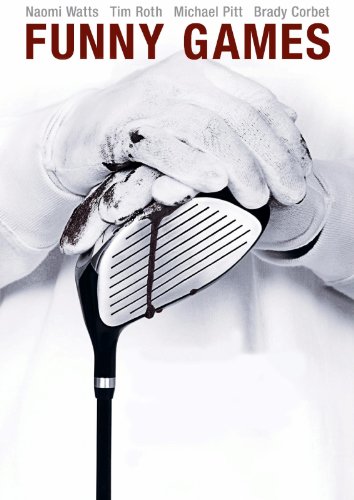
Not for Everyone, But a Very Intelligent, Thought-Provoking Movie If you read film reviews frequently you will occasionally come across the phrase, “this movie indicts the viewer.” Never has this phrase been more appropriate than with Michael Haneke’s “Funny Games,” an Americanized remake of his 1997 film of the same name. Unlike the majority of people who will see this movie, I have not (yet) seen the original and knew little about either version before watching this. I didn’t know what to expect when the movie began and, now that it’s ended, I don’t know what to think.The basic summary one can give for this film feels simple enough; a nice suburban family consisting of George (Tim Roth), Ann (Naomi Watts), and their young son Georgie are vacationing at their semi-secluded lake house. Minutes after arriving, two young men appear at their house. Soon, they are being held hostage by the two men and are forced to play a series of little games all revolving around a little bet. The two men bet that the family will be dead by 9 a.m. the next morning and the family bets they’ll be alive.Well…something like that. The set-up appears to be just your average set-up for a hostage/slasher movie. But that’s not what this film is at all. If you’re looking for a horror film or a psychological thriller, start looking elsewhere. “Funny Games” is an indictment of moviegoers who are so accustomed to seeing on-screen violence we’re desensitized to everything.Here is a film where we have two, clean-cut, innocent looking men who just happen to be killers. They have no motive or explanation for what they’re doing. We have a typical suburban family who have no idea what’s going on and react appropriately and realistically to the situations they’re thrown into.The film absolutely defies convention in every aspect. Not a single thing that occurs in this film is predictable, there’s not a single cheap thrill here, and it’s really just a brilliant piece of filmmaking. For a critique on the apathetic quality moviegoers have to violence against innocent people, it’s brilliant how Haneke allows a film that could have been very violent and gory to have little on-screen violence. To further the indictment of the audience, Michael Pitt’s character will talk directly to the camera, making the audience a part of what is going on.In the hands of a different writer/director this could’ve become an annoying plot device. Enough about that though, let’s discuss one of the most pivotal aspects of the film; the acting.Watts and Roth are so believable, you do empathize with their characters….These are the kinds of performances where they completely embody who they’re playing rather than just playing a character. Pitt and Brady Corbet as the psychotic duo are quietly blood-chilling and wholly believable.I’m guessing Haneke’s goal with his Americanized version is just to present the film to a broader audience but whatever the goal…”Funny Games” is a film that deserves to be viewed, thought about, and discussed. It’s not very entertaining, nor is it meant to be, and it’s not very satisfying either (once again though, it wasn’t meant to be). It’s definitely a thinking person’s movie, but it’s an important film. See it.GRADE: B+
If you hated this movie… CONGRATULATIONS! That was the point.Funny Games, if you’ve never seen this the first thing you probably noticed about it was the overwhelming amount of negative reviews which is why I would say Funny Games is less a movie and more of an experience to torture the audience as much as the victims are tortured. An upper class family are terrorized by two psychopaths in their summer villa. That’s the story, but it’s not what the story is, it’s how it’s told.I’ve condemned other movies for being manipulative and exploitative, such as The Woman or We Need to Talk About Kevin. Funny Games is also manipulative and exploitative, however it doesn’t use those tactics simply for plot convenience but to tell you a tired and true message in the most visceral way possible, while The Woman used cheap manipulation to make you hate white men and We Need to Talk About Kevin used piss-poor parenting to make Kevin look like an evil mega-genius.A reviewer on here noted that people who liked Hostel and Saw will probably enjoy this film, but I’d say it’s quite the contrary. Those movies use a slap-dash mystery plot, extreme violence/gore, and some sort of resolution at the end, all the while entertaining you with the over-the-top deaths. Funny Games has no violence, almost no plot, and no resolution, it’s all just sick mind games; and the reason it’s so effective is because it sets up age-old slasher tactics to make the audience cheer for the family while booing and hissing at the bad guys. Instead of getting a nice happy resolution with maybe a few unimportant side-characters getting picked off in the process, Haneke makes you endure each agonizing second of the humiliation and torture and then gives you no pay-off, effectively s***ting on typical expectations. Then there’s the infamous ‘remote control’ scene, where one of the bad guys gets shot then the other rewinds back far enough to save his buddies life and thwart (yet again) the families’ retaliation, you wanted to see a family getting tortured? That’s exactly what you’re getting.I’ve spent quite some time mulling this movie over, why I thought it was effective, what makes it a different type of manipulation, etc, and this movie still baffles angers and confuses me. As a film-lover that is a great thing, a movie made purely for you to hate and condemn, and if you’re looking to be entertained you definately picked the wrong movie, but if you’re looking for a brutal and sadistic experience (and I believe more people are then they would care to admit) and can look past what this movie is but what this movie evokes in people, than you can admire Funny Games for doing what it sets out to do without pulling any punches.So next time you look at that low score, just consider what MIchael Haneke once said “If the film is a success, it will be because audiences misunderstood the meaning behind it”.
Soul Destroying Quite literally. As a technical exercise in film making this is impressive and clever. As a ‘moral lecture’ it is execrable. We witness a family, including their child, being tormented, humiliated, tortured and murdered by two psycopaths. It is truly shocking and offensive, so yes, job done. The target audience may be the people who ‘enjoy’ the ‘Hostel’ and ‘Saw’ franchises, but are they going to (a) see the irony, or (b) care about it if they do? Haneke subverts conventional narrative and plot, puts our demons up on the screen, has them run riot and emerge triumphant. This is a technically accomplished exercise in egregious sadistic nihilism masquerading as an indictment of other, less cold blooded, examples of the genre. No story is played out. There is no hope, no help, no catharsis, no justice and no judgements are made. The viewers deep need to protect and avenge the family is provoked, toyed with (one of the ‘Funny Games’) and denied. This is one of the occasional horror stories that emerge from the real world presented without narrative or plot. In what sense does this confront cinematic violence, except perhaps to remind us that justice is seldom done in this world?The conceit behind the film is therefore obvious, have the audience identify with the family and abhor their merciless tormentors, yet have the family progressively lose all hope and the perpetrators walk away free to do it all again. Its not even a clever conceit. The onscreen violence is minimal, but its basically psychological warfare against anyone with a decent mindset who is unfortunate enough to view it. Against this background it makes no valid points about onscreen violence because it doesnt really address the subject. The target seems to be the moral hypocrisy of a society that consumes ‘torture porn’ but Haneke and his clever fanbase are missing the point. There is nothing inherently wrong in presenting nightmares in entertainment. That is as old as the human race and started when we were in tribes listening to storytellers around campfires. Portraying our demons in fiction for our heroes to destroy is a classic way of exorcising them. We know real life can be appallingly cruel, that why art developed to enhance the good and mitigate the bad. Does that seem reasonable, Michael?Another reviewer posted a positive review with the argument ‘we’re talking about it, so mission accomplished’. The same could of course be said about 911 or the Beslan massacre. I dont know how many casual readers there will be of this piece, and I know if there are, this will only add to the curiosity, but I would seriously urge anyone to avoid this. It is almost diabolically wicked and I felt like I needed a bath after watching it. Tim Roth apparently turned it down at first, pondered the kind of film he was in during shooting and has apparently refused to watch it since completion. I only wish I’d followed his advice. The only small mercy is that Haneke has found film as an outlet. One wonders where his moral superiority, contempt and righteous anger at society might have taken him had he not.