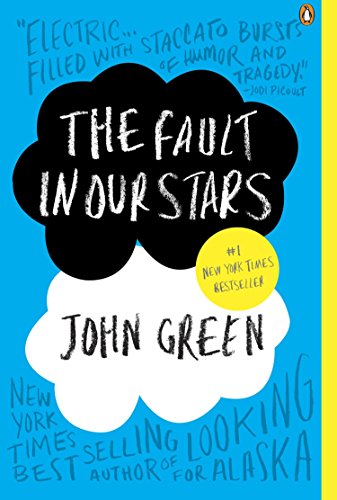

From John Green, the #1 bestselling author of Turtles All the Way Down
“The greatest romance story of this decade.” —Entertainment Weekly
-Millions of copies sold-
#1 New York Times Bestseller
#1 Wall Street Journal Bestseller
#1 USA Today Bestseller
#1 International Bestseller
TIME Magazine’s #1 Fiction Book of 2012
TODAY Book Club pick
Now a Major Motion Picture
Despite the tumor-shrinking medical miracle that has bought her a few years, Hazel has never been anything but terminal, her final chapter inscribed upon diagnosis. But when a gorgeous plot twist named Augustus Waters suddenly appears at Cancer Kid Support Group, Hazel’s story is about to be completely rewritten.
Insightful, bold, irreverent, and raw, The Fault in Our Stars brilliantly explores the funny, thrilling, and tragic business of being alive and in love.
Amazon Best Books of the Month, January 2012: In The Fault in Our Stars, John Green has created a soulful novel that tackles big subjects–life, death, love–with the perfect blend of levity and heart-swelling emotion. Hazel is sixteen, with terminal cancer, when she meets Augustus at her kids-with-cancer support group. The two are kindred spirits, sharing an irreverent sense of humor and immense charm, and watching them fall in love even as they face universal questions of the human condition–How will I be remembered? Does my life, and will my death, have meaning?–has a raw honesty that is deeply moving. –Seira Wilson
Product Features
- John Green
- romance
- Death & Dying
From a teen-age survivor
The best stories are about memory The best stories are about memory.The Fault in Our Stars by John Green is quite possibly the best standalone novel I have ever read and is certainly the most phenomenal book Iâve had the privilege to experience in the year 2013. It is my third favorite story and favorite non-fantasy novel. The title comes from Shakespeareâs Julius Caesar, and it sets the perfect tone for this story written in the first person by Hazel, a sixteen year old girl in the regressive stage of lung cancer who nevertheless is required to cart around an oxygen tank because (as she so perfectly puts it) her âlungs suck at being lungs.â Her mother forces her to go to a cancer patient/survivor group where she proceeds to exercise her considerable teenage snark and wit along with her friend Isaac who is suffering from a type of cancer that eventually requires the removal of an eye.One day Hazel catches the attention of a boy named Augustus and their romance is as breathtaking and expedient as it is completely genuine and uncontrived. Augustus has recovered from bone cancer that left him with a prosthetic leg, but did nothing to diminish his spirit. She can scarcely believe heâs as perfect as he projects and indeed feels as though sheâs found his hamartia or fatal flaw when he puts a cigarette in his mouth. Hazel is of course livid that anyone who survived cancer would willingly place themselves into its way again, but Augustus never lights them using the act as a metaphor of having âthe killing thing right between your teeth, but you not giving it the power to do its killing.âBoth of them together have enough wit and snark to drown the world in metaphors and sarcasm with just the barest dash of bitterness for their plight. Hazel whom Augustus calls âHazel Graceâ for most of the novel feels incredibly guilty that sheâs allowed Augustus to fall for her as she and her family expect her cancer to return full force at any moment, and yet their relationship parallels the ever moving train of her mortality. So much so that Hazel shares with him that her favorite book is a story by the reclusive author Peter Van Houten called An Imperial Affliction.âMy favorite book, by a wide margin, was An Imperial Affliction, but I didnât like to tell people about it. Sometimes, you read a book and it fills you with this weird evangelical zeal, and you become convinced that the shattered world will never be put back together unless and until all living humans read the book. And then there are books like An Imperial Affliction, which you canât tell people about, books so special and rare and yours that advertising that affections feels like a betrayal.âVan Houtenâs work is very meta to the larger story at hand being about a girl named Anna who suffers from cancer and her one-eyed mother who grows tulips. But Hazel makes it very clear that this is not a cancer book in the same way that The Fault in Our Stars is not a cancer book. Anna grows progressively sicker and her mother falls in love with a Dutch Tulip Man who has a great deal of money and exotic ideas about how to treat Annaâs cancer, but just when the DTM and Annaâs mom are about to possibly get married and Anna is about to start a new treatment, the book ends right in the middle of a-Exactly.This drives Hazel and eventually Augustus up the wall to not know what happened to everyone from Annaâs hamster Sisyphus to Anna herself. Hazel assumes that Anna became too sick to continue writing (the assumption being that her story was first person just as Hazelâs is), but for Van Houten to not have finished it seems like the ultimate literary betrayal.As terrified as Hazel was to share this joy with Augustus (and god knows I understand that feeling) it was the best thing she couldâve done because they now share the obsession and the insistence that the characters deserve an ending.The conversations of Hazel and Augustus are not typical teenage conversations, but theyâre not typical teenagers. Mortality flavors all of their discussions and leads to elegance such asâThe tales of our exploits will survive as long as the human voice itself. And even after that, when the robots recall the human absurdities of sacrifice and compassion, they will remember us.âThey speak of memory and calculate how there are fourteen dead people for everyone alive and realize that remembering fourteen people isnât that difficult. We could all do that if we tried that way no one has to be forgotten. But will we then fight over who we are allowed to remember? Or will the fourteen just be added to those we can never forget? They read each other the poetry of T.S Eliot, the haunting lines of Prufrock,âWe have lingered in the chambers of the seaBy sea-girls wreathed with seaweed red and brownTil human voices wake us, and we drown.âAnd as Augustus reads Hazel her favorite…