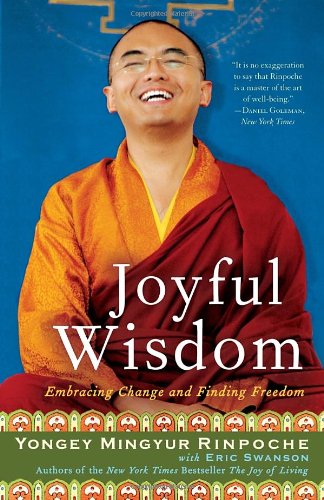

Yongey Mingyur is one of the most celebrated among the new generation of Tibetan meditation masters, whose teachings have touched people of all faiths around the world. His first book, The Joy of Living, was a New York Times bestseller hailed as “compelling, readable, and informed” (Buddhadharma) and praised by Richard Gere, Lou Reed, and Julian Schnabel for its clarity, wit, and unique insight into the relationship between science and Buddhism.
His new book, Joyful Wisdom, addresses the timely and timeless problem of anxiety in our everyday lives. “From the 2,500-year-old perspective of Buddhism,” Yongey Mingyur writes, “every chapter in human history could be described as an ‘age of anxiety.’ The anxiety we feel now has been part of the human condition for centuries.” So what do we do? Escape or succumb? Both routes inevitably lead to more complications and problems in our lives. “Buddhism,” he says, “offers a third option. We can look directly at the disturbing emotions and other problems we experience in our lives as stepping-stones to freedom. Instead of rejecting them or surrendering to them, we can befriend them, working through them to reach an enduring authentic experience of our inherent wisdom, confidence, clarity, and joy.”
Divided into three parts like a traditional Buddhist text, Joyful Wisdom identifies the sources of our unease, describes methods of meditation that enable us to transform our experience into deeper insight, and applies these methods to common emotional, physical, and personal problems. The result is a work at once wise, anecdotal, funny, informed, and graced with the author’s irresistible charm.
From the Hardcover edition.
Good book on Buddhist philosophy and meditation This book primarily discusses Tibetan Buddhist philosophies and meditation. Rinpoche states what Tibetan Buddhists believe to be the sources of mental suffering and anxiety, which he claims is caused by natural causes (aging, illness) and self-inflicted causes (attachment to thoughts, perceptions). He posits that one can become more accepting of change and also reduce suffering by becoming less attached to one’s thoughts and perceptions, which can be achieved by meditating regularly and also adopting some Buddhist viewpoints.The book does a good job of explaining Buddhism and, more importantly to me, meditation. Most of the content is well written and easy to comprehend.Rinpoche has written two books. Joyful Wisdom primarily discusses Buddhist philosophy. His other book, the Joy of Living, goes more into depth of meditation. If you want to learn about Buddhism, choose this book. If you want to learn how to meditate then choose the other book, which is the best book I have read on the topic of meditation.
the real deal I just finished this wonderful book, and I am still filled with the warm glow of wisdom from this true Buddhist master. Amazingly, Rinpoche has been able to explain in scientific terms the pathways to human joy, its causes and effects. I would recommend “Joyful Wisdom” to anyone interested in clear, practical Buddhist teaching, or really anyone that would like to cast off depression, anger, and other feelings that stop us all from moving forward and embracing life. This is a truly magical book which will be read and reread for generations.