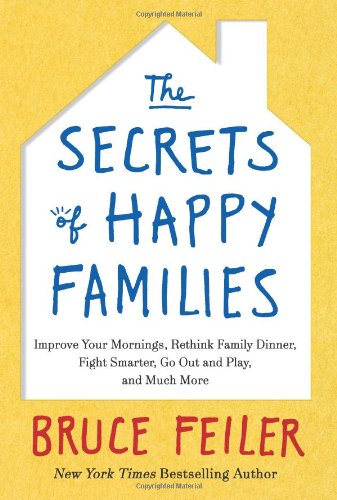

In The Secrets of Happy Families, New York Times bestselling author Bruce Feiler has drawn up a blueprint for modern families — a new approach to family dynamics, inspired by cutting-edge techniques gathered from experts in the disciplines of science, business, sports, and the military.
The result is a funny and thought-provoking playbook for contemporary families, with more than 200 useful strategies, including: the right way to have family dinner, what your mother never told you about sex (but should have), and why you should always have two women present in difficult conversations…
Timely, compassionate, and filled with practical tips and wise advice, Bruce Feiler’s The Secrets of Happy Families: Improve Your Mornings, Rethink Family Dinner, Fight Smarter, Go Out and Play, and Much More should be required reading for all parents.
A.J. Jacobs, author of Drop Dead Healthy and The Know-It-All, interviews Bruce Feiler about The Secrets of Happy Families.


A.J.: Congratulations on this book — it’s amazing. I predict that my family’s happiness level will rise approximately 63 percent after I incorporate these tips. You say you read tons of parenting books and most were eye-glazingly dull. Why?
Bruce: First, 63 percent. That’s better than our family! As for parenting books, the biggest problem is they’re out of fresh ideas. Meanwhile, in every other world – from Silicon Valley, to corporate America, to elite peace negotiators, to the U.S. military – there are cutting-edge ways to bring groups closer together. I asked what those folks were doing with their families, then tested their ideas out with mine.
A.J.:I absolutely love the idea of weekly family meetings. I’m going to start holding them this week. Any tips for keeping kids from zoning out?
Bruce: Holding weekly family meetings is the single best improvement we made to our family. My wife adores them. Tips: play a short game at the start; have your kids pick their punishments; stop after 20 minutes. Oh, and give allowance at the end; that keeps ‘em interested!
A.J.: You talked to a number of experts about how to fight smarter, including simple changes you could make around the home. Which of these improved your life?
Bruce: My wife and I changed where we have conversations at night after we discovered we fought more because my spot put me a power position. As a family, we implemented one of my three favorite tips from the entire book: when we discipline our kids, we sit in upright, cushioned chairs. (My other favorites are “The Law of Two Women” and the “What Do You Know?”)
A.J.: As you point out, the Tiger Mom approach has some downsides. Is there an animal you more identify with?
Bruce: Pillow pet.
A.J.: In the section on Warren Buffett’s guide to allowance, you talk about the importance of having kids work. But the lemonade stand market seems overcrowded. Any alternative?
Bruce: First, I was quite surprised by the advice that it’s better for kids to earn – and lose – their own money. Buffett’s banker told me, “It’s much better to make a mistake with a $6 allowance than a $60,000 salary or a $6 million inheritance.” And I’m a believer in lemonade stands, but remember that the lemonade’s a loss leader — the money’s in the cookies.
A.J.: Are you worried you can never lose your temper at your kids in public, or people will say “Hey, aren’t you the Happy Family guy?”
Bruce: Oops, was that you behind me at the supermarket the other day? Seriously, I wrote about happy families not because we had one, but because we wanted one. Unlike most “experts,” I didn’t have an ideology to promote. I had a question: What do happy families do right and how can the rest of us make our families happier? We’ve definitely improved, but kids change, so we keep having to turn back to the book.
A.J.: You start off with Tolstoy’s famous maxim “All happy families are alike.” Do you agree?
Bruce: I didn’t at first, but now I do. Happy families have certain larger things in common: They adapt all the time. They talk. A lot. They go out and play. And they work at it. We try to improve at our jobs, our hobbies, even at being ourselves, yet somehow we forget to work on the one thing that most defines our well-being — our family. That’s my biggest takeaway. Want to have a happier family? Try.
The “secrets” are not secret – nothing particularly new here The title promises to reveal “the secrets of happy families.” In the Introduction, Feiler promises to tell us about “myth-shattering research from neuroscience to genetics” which has “completely reshaped our understanding of how parents should discipline their children” (p. 5). These promises are not fulfilled. The secrets are not secrets, and Feiler bases his recommendations not primarily on new research but on popular books from the 1980s and 1990s about business (Steven Covey) and about marriage (Gary Chapman).Early on, Feiler informs us that he has no interest in speaking with actual therapists or indeed with any professional who actually works with families and children. Instead, he decides in advance that he will consult only with experts in “technology, business, sports, and the military” (p. 6). He is confident that he doesn’t need to talk with people who are experts on parenting or families; “we can speak to anyone who’s expert in making groups run more smoothly” and then apply their advice to the family (p. 29). OK, but that assumption overlooks a significant difference between a group of businesspeople at work and a family: namely that a family contains CHILDREN. Children are not adults. Strategies which work well with adults may not work so well with 5-year-olds. Feiler never considers this possibility.Feiler is determined not to learn anything from people who actually know something about child and adolescent development, and it shows. For example, Feiler asserts that teenage sexual behavior is “largely unchanged over the last sixty years” (p. 131). If he had bothered to consult with any of the actual experts, he would have learned how false that statement is. For example, in 1950 only about 13% of American teenage girls had experienced intercourse; by 1999 the figure was about 50% (see for example Wells & Twenge “Changes in Young People’s Sexual Behavior 1943 – 1999″, Review of General Psychology, 2005, a widely-cited paper well known to the actual experts whom Feiler disparages). This change has had enormous consequences for the ways in which American girls construct their self-concept and their ideas about sexual intimacy, both for good and ill, but Feiler is blissfully ignorant of all this research, because he will speak only with experts in “technology, business, sports, and the military”.In view of Feiler’s deliberate ignorance of most of the published research, it’s not surprising that many of his recommendations are strange. For example, Feiler describes how a father approved his son’s decision to buy a first-person-shooter video game, but the father vetoed the boy’s desire to play paintball or other actual games that don’t involve screen time (p. 100). Feiler describes himself as “impressed” by the father’s decisions (p. 101). I was not so impressed. I was puzzled why Feiler would endorse the decision to encourage a boy to play a violent video game rather than engaging in an actual outdoor game of paintball. Feiler provides no explanation.Ignorance has its consequences. In chapter 12, on youth sports, he describes a 10-year-old girl, Zoe, who was playing in a soccer game when she was struck in the head by a soccer ball “and fell to the ground.” It must have been a pretty serious hit, because her father “suddenly went limp” when he saw the injury (p. 213). But after a moment, Zoe “took a sip of water, had a short walk, and decided to stay in the game.” Everybody applauded her “resilience.” Feiler shows no awareness of the scholarly literature on concussion – no awareness that Zoe may have suffered a concussion, no awareness that the decision whether or not to return to the field after a head injury should not be made by the 10-year-old who has just suffered the head injury. Other parents who read Feiler’s enthusiasm for a 10-year-old girl who demonstrates “resilience” by returning to a soccer game after a head injury may mistakenly think that such behavior is appropriate or that Feiler is using the term “resilience” appropriately, which he is not. This is an example where Feiler’s determination not to speak with actual experts may conceivably have harmful consequences.But most of Feiler’s recommendations are merely trivial, the reflections of a novice who is not familiar with the published research. He advises that you paint your child’s bedroom in bright colors (p. 181). He tells us that “lighter, more saturated colors are associated with positive emotions, while darker colors trigger negative emotions” (p. 181). He seems unaware of the research suggesting that this association may be true for girls but not for boys. His recommendations are seldom informed by research; contrary to his promise in the opening chapter that he is going to tell us about “myth-shattering research from neuroscience to genetics” most of his suggestions are merely banal.Chapter 1, “The Agile Family Manifesto: a twenty-first-century plan…
enjoyable read, some interesting concepts applied to families from other disciplines I enjoyed reading this book a lot. The author has an engaging way of writing about his family and others. Each chapter, on different topics, tells the stories of one or more families as well as talking to experts and scientists on the topic. The topics range from allowances to sex (for parents! not kids!) to fighting. It’s a positive book, that will make you feel good. No preaching or dictating.One of my favorite chapters was “Agile Family Management”. As a software project manager, I’m familiar with agile software development, so it made me laugh and I shared it with my co-workers. However, it’s got a point – if it works for small software teams, why not families? The concepts include self-directed work (children choosing their chores from a list) and weekly checkpoints about what worked and what didn’t. Overall, it’s about engaging your children in the household by letting them take responsibility themselves, rather than dictating what they should do. In this way, they often end up taking on more, because they have a sense of ownership.There was another chapter I enjoyed on family vacations, as my spouse and I love to travel, and have found it more challenging with a new person with his own tastes joining our family. I also enjoyed the chapter on grandmothers and their importance – I’ll be sure to share that one with my mom! Fighting smart and having difficult conversations will prove useful in both family and business life (as some of the lessons here are drawn from business writers). One of the quirkiest chapters was actually on home decorating and how it can affect family happiness. This book was full of surprises – I really never knew where the next chapter was taking me.Part of the reason that the families in the book felt so familiar to me is that the author focuses on families like mine, people dwelling in east coast cities. The author himself lives in Brooklyn and he also writes about his family in Newton Massachusetts. I would argue that this is probably not a book for all families. It really speaks to the upper-middle-class/middle-class more than anything else. If you are in business, you’ll probably be familiar with some of the concepts he’s quoting, like “How to get to Yes” author William Ury, Stephen Covey’s 7 Habits, and Agile development. I guess that doesn’t mean it won’t appeal to other types of families, but it definitely has a familiarity to a certain part of the world and type of lifestyle or career that I imagine might be quite different for, say, a family of farmers in Kansas. Then again, some concepts are universal – family dinner, spending time together.
Fight Smarter. This is a very good book for anyone with children, because it gives a host of practical tips. My wife and I tried two of the suggestions right off the bat, and they really worked. The suggestions on family dinner, date night, and fighting smarter are priceless. The most useful part for me was the discussion of things that Gen X wanted from their parents and are giving to their children, but their children really don’t want it. For example, today’s parents think kids want a lot of attention, but most current parents tend to smother their kids with activities, events, lessons, etc. What today’s kids really want–for their parents to be less tired and stressed–would naturally occur if parents relaxed and did the little things that both parents and kids really need. Less hoopla, more solid parenting. Feiler explains how. Excellent book.