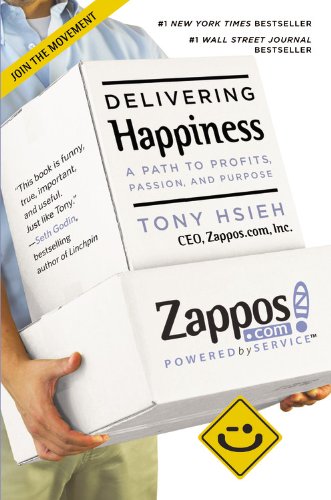

Now in trade paperback, the hip, iconoclastic CEO of Zappos shows how a different kind of corporate culture can make a huge difference in achieving remarkable results — by actually creating a company culture that values happiness –and then delivers on it.
- Pay brand-new employees $2,000 to quit
- Make customer service the responsibility of the entire company-not just a department
- Focus on company culture as the #1 priority
- Apply research from the science of happiness to running a business
- Help employees grow-both personally and professionally
- Seek to change the world
- Oh, and make money too . . .
Sound crazy? It’s all standard operating procedure at Zappos, the online retailer that’s doing over $1 billion in gross merchandise sales annually. After debuting as the highest-ranking newcomer in Fortune magazine’s annual “Best Companies to Work For” list in 2009, Zappos was acquired by Amazon in a deal valued at over $1.2 billion on the day of closing. In DELIVERING HAPPINESS, Zappos CEO Tony Hsieh shares the different lessons he has learned in business and life, from starting a worm farm to running a pizza business, through LinkExchange, Zappos, and more. Fast-paced and down-to-earth, DELIVERING HAPPINESS shows how a very different kind of corporate culture is a powerful model for achieving success-and how by concentrating on the happiness of those around you, you can dramatically increase your own.
The visionary CEO of Zappos explains how an emphasis on corporate culture can lead to unprecedented success.
Pay new employees $2000 to quit. Make customer service the entire company, not just a department. Focus on company culture as the #1 priority. Apply research from the science of happiness to running a business. Help employees grow both personally and professionally. Seek to change the world. Oh, and make money too.
Sound crazy? It’s all standard operating procedure at Zappos.com, the online retailer that’s doing over $1 billion in gross merchandise sales every year.
In 1999, Tony Hsieh (pronounced Shay) sold LinkExchange, the company he co-founded, to Microsoft for $265 million. He then joined Zappos as an adviser and investor, and eventually became CEO.
In 2009, Zappos was listed as one of Fortune magazine’s top 25 companies to work for, and was acquired by Amazon later that year in a deal valued at over $1.2 billion on the day of closing.
In his first book, Tony shares the different business lessons he learned in life, from a lemonade stand and pizza business through LinkExchange, Zappos, and more. Ultimately, he shows how using happiness as a framework can produce profits, passion, and purpose both in business and in life. (edited by author)
Amazon Exclusive Author Q&A with Tony Hsieh, Author of Delivering Happiness

1. In the book you say, “I’ve been an entrepreneur for most of my life.” Do you think people are born entrepreneurs or do they become them?
I think usually by the time you’re 12 years old, you either have the entrepreneurial spirit or you don’t. I would describe the entrepeneurial spirit as a combination of creativity and optimisim.
2. Could you name one particular experience that inspired you to create a company devoted to customer happiness?
For me, it’s really been driven by daily examples of bad customer service in my everyday personal life.
3. Was the worm farm really the invaluable catalyst for forming your business and life philosophy?My parents tell me that as a kid I was always trying to come up with different business ideas. The idea of starting a worm farm is my earliest memory of a business idea.
4. You say that you have always been an avid book reader. What are your favorite books? Which non-business book helped you grow professionally?
Business books: Good to Great, Peak, Tribal Leadership Made to Stick
Non-business books: The Happiness Hypothesis Comedy Writing Secrets The Game
5. What is the ratio between rebelling against conventional wisdom and sticking to the good old truths in building a successful business?
1:10
6. You describe your way to happiness starting with profits, then going through passion and finally getting to purpose. Is that the only path to business happiness?
No, that was just the path that I happened to take. Part of the purpose of the book is to help other entrepreneurs and business owners shortcut the process and encourage them to go straight to combining profits, passion, and purpose.
7. You seem to have taken risks with business ideas a lot while growing up. How do you recognize a risk that you shouldn’t take?
I think it just comes down to really breaking down what the worst case scenario actually is. For most of us, we’re lucky to live in a time and in a society where we aren’t actually ever in danger of dying from starvation or lack of shelter. Most of us have friends whose couches we can crash on in the worst case scenario, so any “risk” we take in starting a company isn’t actually that big a risk.
A must-read for inspiration … plus two other suggested titles for practical implementation There has been quite a crop of customer service related books recently, as well as the classics in the field. They each have their own angle, and I’m going to use this brief review as a chance to summarize where Delivering Happiness falls in this group as well as how to complement it with a couple of other books with different approaches that make for a very well-rounded outlook in tandem.As far as [[Delivering Happiness: A Path to Profits, Passion, and Purpose:]] I was privileged to get a galley of this much-anticipated title. It’s the story of an entrepreneur and the different paths he took (or twists in the one path, depending on how you look at it). A fascinating story, and not just because of the bezillion dollars he got selling the company to amazon. (And: how can you not like a guy who calls his warehouse WHISKY (WareHouse Inventory and Supply in Kentucky — Page 118)? Heavy emphasis on his pursuit of happiness for himself and his staff — very admirable and inspiring. If you’re looking to directly transform your customer service/customer experience, you may want to add to Tony’s inspiring autobiography some directly actionable books to help you turn his ideas into techniques you can put into practice right away — and that are highly consonant with Tony’s pro-employee, pro-customer, outlook — I suggest two books –one a classic, one that’s new this Spring — that can take care of this for you.1. The new book of the season on customer service in a social media and tech-informed context: [[]] I found “High-Tech, High Touch Customer Service” helpful (and a fun read) starting on page 1. Lots of practical, success-oriented insights for business on how to actually implement what is great about Zappos, Four Seasons, and many others, as well as hilarious insights on where companies go wrong.Where does High-Tech, High-Touch Customer Service especially shine? In the way it’s up to the minute on social media, smartphones, apps, connectivity in general, and the trend toward self service, explaining in practical terms where they fit into the customer service picture and where they can be safely ignored. As someone in business, I found this absolutely invaluable — especially since it’s written in a truly non-intimidating and fun style.2. A venerable, wonderful classic: [[Customers For Life: How To Turn That One-Time Buyer Into a Lifetime Customer]] This is an older title, and a classic: how a texas cadillac dealer, of all people, mastered great customer service. Extremely simple, but never simplistic. Has inspired many business leaders since it was written. Many pages have usable, actionable insights. If you don’t have this in your library (and in your psyche) yet, why not? You can probably grab it used for next to nothing, and the wisdom is timeless enough that you hardly need the “latest revised edition” if you need to save a few dollars.
corporate celebration This book traces Tony Hsieh’s rapid progress in the business world, from callow party dweeb with a high IQ to his selling of Zappos to Amazon for north of a billion dollars. Along the way, we get some ups and downs in business startups, the hunt for money, the hunt for the secret to corporate long-term success, and some input from partners and employees along the way. Zappos’ leadership eventually decided to emphasise sterling customer service as the key to their own corporate culture, and the last third of the book – the part worth reading – covers what this means to the customer, to the employees tasked with turning it into a reality, and to the bottom line. The idea was to infuse ten larger values (with numerous sub-meanings and applications) into every aspect of every department of the company. Since Hsieh is now a billionaire or very close to it, one can say that, certainly in this case, it worked.In general the book is a very light read. It is destined to be given out to employees for free, and to serve as a sort of corporate diary and the documentation of the corporate mythology. That’s not necessarily bad, just what it is. The last few pages are a little more thoughtful, where the author tries to relate his business experience to a philosophical discussion of life, the universe and everything. This stuff might be a bit of a stretch, but it is the kind of expansive view of things one can expect from a businessman in his position and there are few business books by hugely successful authors that can resist this kind of thing.