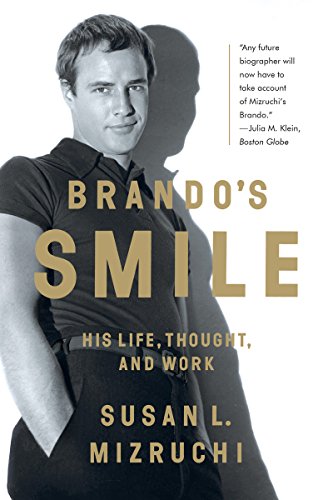

A groundbreaking work that reveals how Marlon Brando shaped his legacy in art and life.
When people think about Marlon Brando, they think of the movie star, the hunk, the scandals. In Brando’s Smile, Susan L. Mizruchi reveals the Brando others have missed: the man who collected four thousand books; the man who rewrote scripts, trimming his lines to make them sharper; the man who consciously used his body and employed the objects around him to create believable characters; the man who loved Emily Dickinson’s poetry.
To write this biography, Mizruchi gained unprecedented access to a vast number of annotated books from Brando’s library, hand-edited copies of screenplays, private letters, and recorded interviews that have never before been quoted in a biography. Original interviews with some of the still-living players from Brando’s life, including Ellen Adler, his one-time girlfriend and the daughter of his acting teacher Stella Adler, provide even deeper insight into the complex person whose intelligence belied the high-school dropout.
Mizruchi shows how Brando’s embrace of foreign cultures and social outsiders led to his brilliant performances in unusual roles―a gay man, an Asian, a German soldier―to test himself and to foster empathy on a global scale. We also meet the political Brando: the civil rights activist, the close friend of James Baldwin, the actor who declined his Oscar to support Indian rights.
More than seventy stunning―and many rare―photographs of Marlon Brando illuminate this portrait of the man who has left an astounding cultural legacy.
78 illustrations
brings the man alive for you to hug him and cherish him 0
Marlon Brando, the Incomparable Craftsman. 0
SMILE FOR THE CAMERA Marlon Brando had, yes, a sensational smile, one of the best in all the world – but having just finished reading Susan Mizruchi’s BRANDO’S SMILE I am still trying to figure out why she titled her book thusly. Yes, the title matches the photo of a smiling Brando on the dust jacket – but the actual smile is not discussed all that much within the text. And when it is mentioned in the introduction, it is Ms. Mizruchi’s contention that “When you think of Brando, you don’t think of a smile.” Perhaps she doesn’t, but I do – in addition to Brando’s exquisite use of every other facial expression known to man! She continues: “Granted, comedy was not his forte and most of the characters he played were unaccustomed to happiness.” But comedy isn’t really the point here. The smile is. In the book, the smile is discussed in all of one paragraph. Mention is made of a smile in STREETCAR, WATERFRONT, MUTINY, THE SCORE and TANGO. Yet the example of a smile in TANGO is a poor one. Not discussed is Brando as Paul’s final smile, filled with all the fragile hope and romantic dream and desire for a new beginning in the world, just before his lover shoots him. Instead, a much earlier smirk is mentioned in listing Brando’s “compromised” smiles in film. In life as in his roles, Brando used his stunning smile for varied purposes. I recall the smile Brando’s Rio in ONE-EYED JACKS flashes his nemesis, Karl Malden’s character of Dad, when Rio realizes he has a magnificent means of shafting Dad via use of the step-daughter Louisa. It is probably Brando’s broadest, best, most multi-layered smile ever caught on film. Mention of it is not made in BRANDO’S SMILE. My point is that given the title of the book, a review of the actor’s actual smile and its many uses might have been analyzed in much more depth.There are some small, but still troubling, faults in Ms. Mizruchi’s interpretation of certain movie moments as well. Three should suffice: the first is from the above mentioned ONE-EYED JACKS and is on page 145. According to the authoress, Rio betrays Dad when Rio does the bullet-in-hand bit to determine who will ride the lone horse to get help. She feels that Rio feels that staying to hold off the Mexican police is less dangerous than high-tailing it for help, and so purposefully deceives and betrays Dad by having a bullet hidden in each hand so that Dad will have no choice but to leave. The truth is, though, that Rio does his deceit out of his love for Dad because holding the ridge is by far the more perilous task. It is an important point – and is paralleled later in the film when Louisa tries to pass two derringer bullets to imprisoned Rio.Another misread of a movie is in saying that Montgomery Clift was the first leading American actor to play a homosexual in film, in SUDDENLY LAST SUMMER. The trouble is, Clift’s character in that film is not a homosexual. The cannibalized character of Sebastian, however, is.When it comes to THE CHASE, it seems Ms. Mizruchi feels that there is slow-motion in the scene wherein Brando’s character is beaten up – and that Brando’s “creative use of film technology” in recommending that the scene be filmed at a higher speed led directly to the slow motion death of Bonnie and Clyde in Arthur Penn’s (same director of THE CHASE) film about the criminal couple. (On one page we are told the camera speed was increased; on another that the beating scene was shot a slow speed so that when it was run at regular speed the actual body contact hits looked real.) The point of all this is, however, that there is no slow motion in the scene as shown in the film. As for Penn getting the inspiration somehow from Brando to use slow-motion for a scene of violence, the fact is Penn used slow-mo in 1958′s THE LEFT-HANDED GUN. Anyway, to say that Brando’s recommendation to film the fight slower so that the actors could actually make their blows connect led to the actual use of slow motion in Penn’s BONNIE AND CLYDE is a stretch and a confusing one at that, as told herein.The book’s subtitle is HIS LIFE, THOUGHT AND WORK. Regarding his LIFE we curiously learn nothing about Brando’s bisexuality, and are given next to naught as to details of his death. And even though we learn that he was in NYC on 9/11, we learn nothing of substance about the thoughts and feelings of a man who spent much of his life embracing foreign cultures. Little is told of why Brando was booed at a September 10th Michael Jackson event at Madison Square Garden by the youthful crowd when discussing worldwide hunger, or how this very real rebel dealt with the idiocy of that crowd. As for his WORK, curiously absent is any substantive mention of several of the actor’s films, such as MORITURI, THE APPALOOSA, THE NIGHT OF THE FOLLOWING DAY, CANDY, A COUNTESS FROM HONG KONG (would love to learn more about his relationship with director Charlie Chaplin!) and most curiously THE BRAVE in which Brando…