
0
0
0
0
0
0
0
0
0
or copy the link
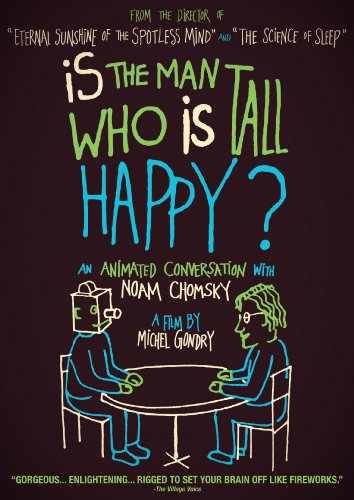
From Michel Gondry, the innovative director of Eternal Sunshine of the Spotless Mind and The Science of Sleep, comes this unique animated documentary on the life of controversial MIT professor, philosopher, linguist, anti-war activist and political firebrand Noam Chomsky. Through complex, lively conversations with Chomsky and brilliant illustrations by Gondry himself, the film reveals the life and work of the father of modern linguistics while also exploring his theories on the emergence of language. The result is not only a dazzling, vital portrait of one of the foremost thinkers of modern times, but also a beautifully animated work of art.
Well-worth your time 0
This titke of the film may sound like a joke but the film is very serious because of the stakes it brings up.The first one is Gondry’s idea expressed from the very start that film and video are manipulative.“Film and video are both, by their nature, manipulative. The editor or director proposes an assembly of carefully selected segments that he/she has in mind. In other words, the context becomes more important than the content, and, as a result, the voice that appears to come from the subject is actually coming from the filmmaker. That is why I find the process manipulative. The human brain forgets the cuts — a faculty specifically human that, I will learn, Noam calls “psychic continuity.” The brain absorbs a constructed continuity as a reality and, consequently, gets convinced to witness a fair representation of the subject. On the other hand, animation that I decided to use for this film is clearly the interpretation of its author. If messages, or even propaganda, can be delivered, the audience is constantly reminded that they are not watching reality, so it’s up to them to decide if they are convinced or not.”The animation is absolutely mesmerizing, which is a compliment, hypnotizing, and you just don’t hear what is being said at all. At the same time if you are concentrating on what is being said, which is always difficult because man is a visual dominant being, you do not see the animation any more. Film or video – and I believe the two are not the same at all (I can absolutely overlook subtitles on a video screen whereas it is practically impossible for me to do the same on a cinema screen) at least if I follow Marshall McLuhan – are by definition visual first and thus by definition manipulative. If the images are not plainly supporting the discourse, the discourse is not understood. Many experiments have been done on the subject, among others as reported by Marshall McLuhan. Thus the best film or video setting for an interview is just the plain image of the interviewee and the interviewer.This film is thus highly manipulative and you need to watch it at least twice if you want to both appreciate the animation and the interview. Or you can cheat like me and use the movie script available at http://www.springfieldspringfield.co.uk/movie_script.php?movie=is-the-man-who-is-tall-happy. Gondry is wrong about animation not disturbing the meaning of the interview. First as I have said it interferes with the reception of the interview. But second it does perverts the interview because the brain does not work the same way for a visual message that has to be analyzed in patterns that have no semantic meaning per se (there is no dictionary of animated patterns) but can only find a meaning in the way these visual patterns are analyzed by the brain and the mind bringing into the interpretation of the received images all that it, the brain, or rather they, the brain and the mind, has or have accumulated in years of life and experience. At the same time Gondry recognizes several times he did not understand Chomsky’s meaning and yet he illustrated the concerned passages. Is that the illustration of Chomsky’s meaning or of Gondry’s misunderstanding?Apart from this general remark, I am now going to concentrate on some of the things Chomsky said.Personally I am not interested in his memories about his life. I am only interested in his approach of linguistics and language and there is a lot of that in the interview. The fact that his oldest recollection is dated of when he was 16 months old, the fact that he went to a Dewey progressive school up to the year he moved to a standard public high school, the fact that he spent his Saturday afternoon in the museums of Philadelphia, and many other facts of the type are for me uninteresting. What he says about his family, both ascending and descending, his grand children and his children, and his wife is for me of little interest. What he says about the treatment of Jewish refugees during the war and after the war by the United States is interesting from an historical point of view but very little from a scientific linguistic point of view. His lapsus about Palestine when speaking of Israel is what it is, an old age lapsus that shows the re-emergence of what he said about his father: “He was then a deeply committed zionist, but for him, it was a cultural revival, basically.” That sounds a little bit short. So I will overlook these sections that more or less emphasize, positively or negatively, the age of the man.First remark on Noam Chomsky’s inteview.“The more intensively the topic is studied… [ Camera rattling ] …the more sophisticated the research techniques, the more we learn that children know quite a lot of language, much more than you would expect, before they can exhibit any of that…