
0
0
0
0
0
0
0
0
0
or copy the link
Do men and women laugh at the same things?
Is laughter contagious?
Has anyone ever really died laughing?
Is laughing good for your health?
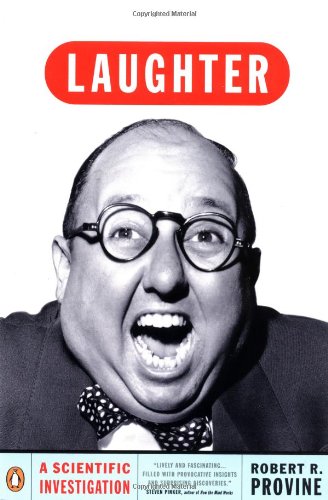
Is it really the best medicine? Neurobiologist Robert R. Provine discovered that no scientist had ever looked into the weird, uncontrollable, and very human phenomenon of laughter, so he started off on his own. Laughter: A Scientific Investigation is his warm and–of course–funny report on how and why we giggle and snort with such regularity. Basing his views on field research conducted in a broad array of social situations (laughter being notoriously difficult to evoke in the laboratory), Provine posits that we use it as a universal, preverbal means of communication. Though animal research is controversial, it suggests that apes establish and maintain relationships using laughlike behavior, so it could be the missing link between animal communication and true language. He also explores instances in which we seem to laugh our way into and out of social situations, and includes a list of tips for keeping the laughs flowing. The irony of the scientific community not taking laughter seriously isn’t lost on Provine, and he takes every opportunity to remind his fellows that even the seemingly most trivial matters can hide the most profound truths. If that isn’t funny, what is? –Rob Lightner
Is laughter contagious?
Has anyone ever really died laughing?
Is laughing good for your health?
Drawing upon ten years of research into this most common-yet complex and often puzzling-human phenomenon, Dr. Robert Provine, the world’s leading scientific expert on laughter, investigates such aspects of his subject as its evolution, its role in social relationships, its contagiousness, its neural mechanisms, and its health benefits. This is an erudite, wide-ranging, witty, and long-overdue exploration of a frequently surprising subject.
No Laughing Matter Don’t expect to get lots of laughs by just reading _Laughter: A Scientific Investigation_ (Viking) by Robert R. Provine. It’s not merely that Provine is covering a serious subject. He is as good as his word: his book is a scientific investigation, and he is neuroscientist by profession who has done original research on laughter published in such non-newsstand rags as _Ethology_ and _Bulletin of the Psychonomic Society_. And it’s not that Provine is an unentertaining, dour writer; he has a light touch, and good explicative skills, he is happy to share a joke, and his stories about some of the ways he has done experiments are funny. For instance, we can share his bemusement over his initial explorations of why people laugh; he got a group into a clinic and played them funny tapes. He failed to get anything but a few chuckles. It was his first demonstration that laughter was a social behavior, not a laboratory one. He went on to study people in social situations.
A Breath of Fresh Air I have been reading, writing, and teaching about humor and laughter for over a decade, and this is one of the best books I have seen. The title is an accurate prediction of the book’s content: The approach blends the skepticism, humility, and freedom from biases that are the defining traits of the true scientist. Provine pursues laughter in its larger context of our history as a species rather than the usual context of the history of Western Thought. He is seeking what laughter actually is and does, not what the army of laughter promotors desire it to be and do. This is, in some ways, a book of questions – the right questions – that will generate productive research. Because Provine follows laughter everywhere it leads, the resulting presentation is wide ranging, taking the reader into a variety of fields that are rarely if ever addressed in the same volume. Although some of these fields (e.g., opera and brain disorders) are highly specialized and esoteric, Provine defines terms and provides background in a way that permits readers to accompany him into unfamiliar territory. This book belongs in the reference library of everyone whose vocation or avocation touches the study of laughter. I would also recommend this book for any thoughtful reader in pursuit of fresh insights. Although some parts may not be of interest to everyone, there is plenty of material about those accessible and universally-appealing topics of sex, power, and the gender wars.