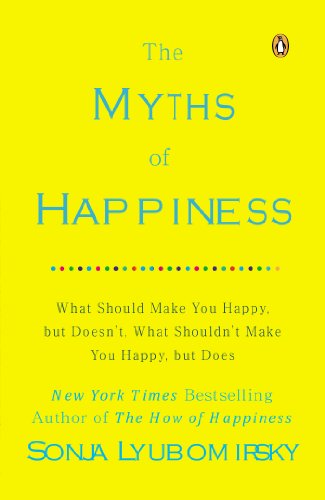

Focusing on life’s biggest, messiest moments, Sonja Lyubomirsky provides readers with the clear-eyed vision they need to build the healthiest, most satisfying life. Lyubomirsky argues that we have been given false promisesmyths that assure us that lifelong happiness will be attained once we hit the culturally confirmed markers of adult success. This black-and-white vision of happiness works to discourage us from recognizing the upside of any negative and limits our potential for personal growth. A corrective course on happiness and a call to regard life’s twists and turns with a more open mind, The Myths of Happiness shares practical lessons that prove we are more adaptable than we think we are. It empowers readers to look beyond their first response, sharing scientific evidence that often it is our mindsetnot our circumstancesthat matters most.
Amazon Exclusive Essay: “Happiness at Work,” by Sonja Lyubomirsky
Recent surveys show that more Americans than ever are dissatisfied with their jobs. Some are burned out or bored, while others feel that professional success has eluded them. Stress over financial well-being–which for many is synonymous with professional success–is a primary source of discontent. Indeed, when people are asked if they could have anything in the world right now, most report wanting “more money. ” Professional unhappiness can cause us to question our judgment, industriousness, or motivation. The lure then of finding a new job can prove irresistible–but will a new job really make us happier?
A seminal study suggests that the answer is no. Researchers followed high-level managers for five years to track their job satisfaction before and after a voluntary job change, such as a promotion or a relocation to a more attractive city. The managers were mostly male and white, with an average age of 45 and a $135,000 annual salary. They were doing well. What the researchers found, however, was that although these managers experienced a burst of satisfaction immediately after the job change, their satisfaction plummeted within a year, returning to their original pre-move level. In other words, they experienced a sort of hangover effect. By contrast, managers who chose not to change jobs during the same five-year time period experienced negligible changes in their satisfaction.
We get used to the cities where we live, to new houses and new cars, to relationships, and even to sex. This capacity to adapt to positive changes in our lives is both formidable and biologically hard-wired. Even the events we are certain will bring long-term fulfillment–landing a coveted professional position, or winning an award–tend to disappoint. We feel an immediate thrill, but that thrill is often followed by satiety, elevated expectations, and even letdown.
This is true even of monetary rewards. In the beginning, greater wealth brings us a higher standard of living, and the extravagances bring extra pleasure. But economists have found that two-thirds of the benefits of a raise in income are erased after just one year, in part because our spending and new “needs” rise alongside it and because we begin to associate with (and compare ourselves to) people in a higher income bracket.
With so much seemingly working against long-term professional satisfaction, it’s important to focus on where our chance for happiness truly resides. When we feel we’ve “had it” with our jobs, should we look for job satisfaction elsewhere or is there a different path?
Research suggests that instead of fantasizing about some dream job that doesn’t exist, we focus on pursuing meaningful goals in the here and now. Typically, our professional lives are focused on material goals–more money, wider recognition–but numerous studies have shown that those of us who are striving (and not necessarily achieving) are happier.
When it comes to our careers, if we enjoy the struggle along the way, we will derive pleasure and satisfaction by simply working on our goals. By doing so, we will ideally stretch our skills, discover novel opportunities and challenges, grow, strive, learn, and become more capable and expert. In this way, simple goal pursuit will provide us with opportunities for appreciation, for delight, and for satisfying our innate need to use our potentials to the fullest. Whether our valued goal is inventing something special or finishing school, it will give us something to work for and to look forward to.
Why is goal pursuit so intrinsically rewarding? Because it imparts structure and meaning to our daily lives, creating obligations, deadlines, and timetables, as well as opportunities for mastering new skills and for interacting with others. Because it helps us attain a sense of purpose, feelings of efficacy over our progress, and mastery over our time. All of these things make people happy. And once we accomplish a step along the way (e.g., completing an internship or an article), we would do well to savor that accomplished subgoal before moving on to a new goal. Instead of focusing too much on the finish line in the first place, we should focus on–and enjoy as much as possible–carrying out the multiple baby steps necessary to make progress. The perfect job may not be the position offering the highest rewards, but rather the place where the daily work–the moments between the big promotion or industry triumph–offers the greatest personal returns.
Happiness: so simple, yet so complicated … “While experiencing happiness, we have difficulty in being conscious of it. Only when the happiness is past and we look back on it do we suddenly realize – sometimes with astonishment – how happy we had been.”¯ Nikos Kazantzakis, Zorba the GreekHappiness, that eternal yet elusive goal of man, is indeed full of paradoxes as many writers have eloquently noted. In an increasingly crowded field of books on happiness and positive psychology where it is getting more and more difficult to say something original and meaningful, I feel the author has made a very worthwhile contribution. She considers some of the universal assumptions about happiness and explores, analyzes, and reframes them to show us how very naive, thoughtless, and just plain wrong is our thinking about what “makes us” happy.These assumptions – the “Myths of Happiness” as her title defines them – include cliches almost all of us never pause to doubt, ideas such as the idea that we can’t be happy without a wonderful marriage, we can’t be happy unless we have children, we can’t be happy because we don’t have enough money, we can’t be happy because we’re not as young as we used to be, we can’t be happy if we have health problems, and a few other common beliefs. It turns out that people find a way to be happy in spite of unwanted life circumstances, and many people who are blessed by wealth and good fortune aren’t any happier that those who lack these fortunes.The unifying theme in dealing with all of these happiness myths seems to be what psychologists call “cognitive flexibility” or “cognitive reframing”, that is, some mental flexibility, creativity, perseverance, and originality that allows people to discover all kinds of alternative paths to a rich, enjoyable, successful, and meaningful life even if we find ourselves without wealth, youth, perfect health, or a passionate romantic partner. Bottom line: Lyubomirsky convinced me that, even if we don’t get what we want in life, we can still achieve that elusive state of living variously known as contentment, fulfillment, satisfaction, or happiness.The author’s writing style is fast-paced, wryly funny, and unpretentious. And, her knowledge of the field is encyclopedic, with over 400 references to studies in human happiness, enjoyably explained, to support her deconstruction of the myths of happiness.I think the measure of a good psychology book is one that really makes you think about your own life differently, and this one gave me several such moments. Nearly 30 years ago as a medical student I had to cancel a planned “externship” at the prestigious Yale University Hospital on very short notice in order to be available to support my then girlfriend through a family loss. Having invested years of sweat and toil in my career and revering the Ivy League as the pinnacle of success, I went into a state of mini-despair as I reluctantly signed up for a mundane, “regular” assignment closer to home. I imagined my entire future success as a medical doctor had just taken a permanent turn for the worse. As it turned out, I was teamed up with an awesome team of residents and attending physicians, learned so much that I still use the knowledge acquired in that un-glamorous assignment in the management of patients, and years later was, nonetheless, still offered a prestigious fellowship at Yale. What’s more, I turned it down, having by then a much better idea of the kinds of things that actually would make me happy. This memory is a pefect example of the author’s main idea, expressed in the book’s subtitle: “what should make you happy but doesn’t, what shouldn’t make you happy but does.” Ultimately, I think nothing extrinsic “makes us” happy, but rather that we must decide internally to experience life as an interesting, challenging, exciting adventure, and with that inner resolve, we will find opportunities to experience a range of emotions and experiences ultimately amounting to a meaningful and happy life.
Good attempt, but book fell short I was excited to start reading this book, but that quickly changed.I was expecting newest research with potentially life-changing implications, but while the book contained references to many studies, the conclusions and research findings were not really new to me(I keep updated with Psychology Today and other sources)Her writing style was good, but became very repetitive. The chapters’ introductions are lengthy and add no real value. In addition, the chapters’ summaries (called “The prepared mind”) have turned out to be a huge third repeat of the same ideas, worth nothing, only more ‘fluff’ (to make the book longer?)Some of her practical solutions were completely absurd, in my opinion. Example: How to appreciate your current job more: If you previosuly worked night shift, you should stay up some nights to try to remember how that feels. Lol. She offers more “practical” solutions of this kind in the book. Frustrated with parenting? When you’re old you’ll have fond memories, so just think of 50 years from now, how great life will be then. Hahaha! Diagnosed with terminal cancer? Just think of yourself as a three legged table, which is actually stronger than a four legged one. I know, I am simplyfying, but the ideas, examples and anecdotes she uses are NOT life-altering, they are interesting, at best, and more often than not, just silly.To be honest, I felt like in order for any of us to be happy, we have to constantly keep “brainwashing” ourselves back into the past. Look at old pictures of your vacations, you’ll feel happier. Remember that horrible boss you once had, but now you’re free of him, so be happy. Her suggestions felt ‘plastic’, inorganic, fake, inauthentic, forced or some type of “let’s pretend” game. Sometimes I felt that my intelligence was insulted.However, not everything in this book was bad. It was truly a mix of some good and some awful ideas. Every reader should keep in mind that she tends to inject some of her own life philosophy into her conculsions.The section worth reading is the one on marriage and long term relationships. I feel like most people are not aware of how over time our relationships change and we get bored. I liked the reminder that we have to constantly work on our relationships, and here her suggestions, although not original by any stretch, were useful and adequate.Also worth your attention – the suggestions on NOT comparing yourself to others. I felt that she could have incorporated the role of social media here, such as Facebook, which leads to constant comparing yourself to others. The author could have included lots of practical examples here, but fell short.Overall, a poor C+. Aside from a few little things here and there, I did not learn much.
acute insights + lots of common sense Large portions of common sense combined with several acute insights based on wide-ranging research helps the reader gain inner satisfaction and increased optimism in this second book by the author. Ms. Lyubomirsky first work, “The How of Happiness” was a useful addition to the literature of happiness and optimism created by such innovators as Martin Seligman and Mihaly Csikszentmihalyi. “Myths” is a major advance in its gravitas and specificity.Few writers have tackled such subjects as loving children but not motherhood, the reasons that single people will be happier if they focus on becoming “your best possible single self” and how to spend money on need-satisfying goals. There are also some fine tips such as creating an autobiographical coherence, writing experiences as a means of relief and realizing that the results of life events are not knowable; what we think of as a calamity might well not be and vice-versa. All in all this is a practical guide which will achieve its goal in a large percentage of its readers.The author, a Professor of Psychology at UCRiverside fully achieves her purpose. This is a step up in self-help books.Stanley Goldstein