Entertaining, Educational, Inspirational…and funny! I wasn’t sure what to expect from this film, but was delighted that it hit home on so many levels. For a generation contemplating our own mortality, the title certainly is a hook. But this is no dry doco, or how-to. Instead, director Wexler takes us through a quixotic assortment of folks who have beaten the clock in one way or the other, and shares their personal stories, and the universal truths they contain. With a journalist’s instinct, Wexler tracks down a delightful assortment of elder statesmen, from the indefatigable Jack LaLanne, to a beer guzzling, cigarette-smoking, marathon-running centenarian (my personal hero). Along the way, you sense that the filmmaker is very concerned with his own mortality, but never loses the sense of irony that makes this movie so watchable (I almost never watch a film more than once, and I’m on my third viewing) and never descends into sentimentality or easy answers.
Looking At Life, Death, And Aging From Every Angle Imaginable We are all going to get older. It’s a fact of life. But what we do with that time is really what distinguishes a life lived. The engaging documentary “How to Live Forever” covers quite a few topics in a short 90 minutes and it gives one a lot to ponder. Filmmaker Mark Wexler approaches the subject of aging and the notion of prolonging life from a very personal angle that serves the piece well. He is singularly fascinated by the many theories and thought processes behind aging. And it’s easy to identify with his questions.At first, “How to Live Forever” seems to posit that we should live to our fullest no matter what our age categorization. We are introduced to many subjects that are reveling in their advanced years, living life to its fullest potential. It’s a great message, one that’s hard to deny. But as he starts to track down why some seem to live longer than others, the proposition becomes a bit trickier. There is not a lot of common ground and his interviewees are as diverse and colorful as can be. While in Japan, clean living and an active lifestyle seems to have raised the age limit, but other results vary with participants who drink, smoke, and have lived a life of excess. Another topic soon follows and the film starts to examine some ways to counteract aging. From hormones treatments to advanced studies of scientific manipulation, the film explores ways of feeling younger and perhaps even staving off death altogether. There are many more discussions to be had including cryogenics and even a trip to a funeral home convention. Literally, the film touches on dozens and dozens of topics.In the end, the focus of “How to Live Forever” appears to jump all over the place. Wexler seems to want the documentary to be a comprehensive look at aging and death. It’s an enormous goal, and the stress of the film is shown getting to him. In the end, the movie raises as many questions as it answers–but it brings up much food for thought. The picture, though occasionally chaotic, is never less than fascinating largely due to the wide array of people who agree to be interviewed. Across the globe, Wexler assembles an engaging cast of well known personages and average people. Among the celebrities that weigh in, they include Ray Kurzweil, Suzanne Somers, Jack LaLanne, Phyllis Diller, Willard Scott and Ray Bradbury. It’s hard not to get swept up in Wexler’s desire and enthusiasm to put things into context. And this search for life’s meaning and purpose subtly sneaks up on you. A good film that poses a number of interesting questions. KGHarris, 5/12.
Looking At Life, Death, And Aging From Every Angle Imaginable We are all going to get older. It’s a fact of life. But what we do with that time is really what distinguishes a life lived. The engaging documentary “How to Live Forever” covers quite a few topics in a short 90 minutes and it gives one a lot to ponder. Filmmaker Mark Wexler approaches the subject of aging and the notion of prolonging life from a very personal angle that serves the piece well. He is singularly fascinated by the many theories and thought processes behind aging. And it’s easy to identify with his questions.At first, “How to Live Forever” seems to posit that we should live to our fullest no matter what our age categorization. We are introduced to many subjects that are reveling in their advanced years, living life to its fullest potential. It’s a great message, one that’s hard to deny. But as he starts to track down why some seem to live longer than others, the proposition becomes a bit trickier. There is not a lot of common ground and his interviewees are as diverse and colorful as can be. While in Japan, clean living and an active lifestyle seems to have raised the age limit, but other results vary with participants who drink, smoke, and have lived a life of excess. Another topic soon follows and the film starts to examine some ways to counteract aging. From hormones treatments to advanced studies of scientific manipulation, the film explores ways of feeling younger and perhaps even staving off death altogether. There are many more discussions to be had including cryogenics and even a trip to a funeral home convention. Literally, the film touches on dozens and dozens of topics.In the end, the focus of “How to Live Forever” appears to jump all over the place. Wexler seems to want the documentary to be a comprehensive look at aging and death. It’s an enormous goal, and the stress of the film is shown getting to him. In the end, the movie raises as many questions as it answers–but it brings up much food for thought. The picture, though occasionally chaotic, is never less than fascinating largely due to the wide array of people who agree to be interviewed. Across the globe, Wexler assembles an engaging cast of well known personages and average people. Among the celebrities that weigh in, they include Ray Kurzweil, Suzanne Somers, Jack LaLanne, Phyllis Diller, Willard Scott and Ray Bradbury. It’s hard not to get swept up in Wexler’s desire and enthusiasm to put things into context. And this search for life’s meaning and purpose subtly sneaks up on you. A good film that poses a number of interesting questions. KGHarris, 5/12.

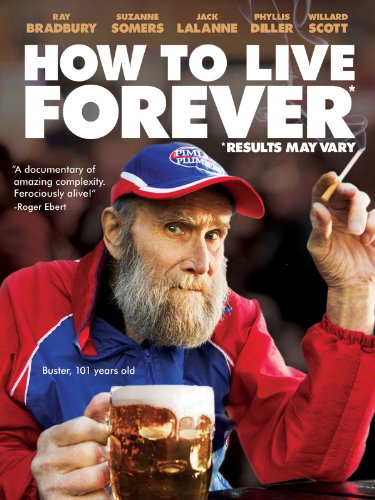
Entertaining, Educational, Inspirational…and funny! I wasn’t sure what to expect from this film, but was delighted that it hit home on so many levels. For a generation contemplating our own mortality, the title certainly is a hook. But this is no dry doco, or how-to. Instead, director Wexler takes us through a quixotic assortment of folks who have beaten the clock in one way or the other, and shares their personal stories, and the universal truths they contain. With a journalist’s instinct, Wexler tracks down a delightful assortment of elder statesmen, from the indefatigable Jack LaLanne, to a beer guzzling, cigarette-smoking, marathon-running centenarian (my personal hero). Along the way, you sense that the filmmaker is very concerned with his own mortality, but never loses the sense of irony that makes this movie so watchable (I almost never watch a film more than once, and I’m on my third viewing) and never descends into sentimentality or easy answers.
Looking At Life, Death, And Aging From Every Angle Imaginable We are all going to get older. It’s a fact of life. But what we do with that time is really what distinguishes a life lived. The engaging documentary “How to Live Forever” covers quite a few topics in a short 90 minutes and it gives one a lot to ponder. Filmmaker Mark Wexler approaches the subject of aging and the notion of prolonging life from a very personal angle that serves the piece well. He is singularly fascinated by the many theories and thought processes behind aging. And it’s easy to identify with his questions.At first, “How to Live Forever” seems to posit that we should live to our fullest no matter what our age categorization. We are introduced to many subjects that are reveling in their advanced years, living life to its fullest potential. It’s a great message, one that’s hard to deny. But as he starts to track down why some seem to live longer than others, the proposition becomes a bit trickier. There is not a lot of common ground and his interviewees are as diverse and colorful as can be. While in Japan, clean living and an active lifestyle seems to have raised the age limit, but other results vary with participants who drink, smoke, and have lived a life of excess. Another topic soon follows and the film starts to examine some ways to counteract aging. From hormones treatments to advanced studies of scientific manipulation, the film explores ways of feeling younger and perhaps even staving off death altogether. There are many more discussions to be had including cryogenics and even a trip to a funeral home convention. Literally, the film touches on dozens and dozens of topics.In the end, the focus of “How to Live Forever” appears to jump all over the place. Wexler seems to want the documentary to be a comprehensive look at aging and death. It’s an enormous goal, and the stress of the film is shown getting to him. In the end, the movie raises as many questions as it answers–but it brings up much food for thought. The picture, though occasionally chaotic, is never less than fascinating largely due to the wide array of people who agree to be interviewed. Across the globe, Wexler assembles an engaging cast of well known personages and average people. Among the celebrities that weigh in, they include Ray Kurzweil, Suzanne Somers, Jack LaLanne, Phyllis Diller, Willard Scott and Ray Bradbury. It’s hard not to get swept up in Wexler’s desire and enthusiasm to put things into context. And this search for life’s meaning and purpose subtly sneaks up on you. A good film that poses a number of interesting questions. KGHarris, 5/12.
Looking At Life, Death, And Aging From Every Angle Imaginable We are all going to get older. It’s a fact of life. But what we do with that time is really what distinguishes a life lived. The engaging documentary “How to Live Forever” covers quite a few topics in a short 90 minutes and it gives one a lot to ponder. Filmmaker Mark Wexler approaches the subject of aging and the notion of prolonging life from a very personal angle that serves the piece well. He is singularly fascinated by the many theories and thought processes behind aging. And it’s easy to identify with his questions.At first, “How to Live Forever” seems to posit that we should live to our fullest no matter what our age categorization. We are introduced to many subjects that are reveling in their advanced years, living life to its fullest potential. It’s a great message, one that’s hard to deny. But as he starts to track down why some seem to live longer than others, the proposition becomes a bit trickier. There is not a lot of common ground and his interviewees are as diverse and colorful as can be. While in Japan, clean living and an active lifestyle seems to have raised the age limit, but other results vary with participants who drink, smoke, and have lived a life of excess. Another topic soon follows and the film starts to examine some ways to counteract aging. From hormones treatments to advanced studies of scientific manipulation, the film explores ways of feeling younger and perhaps even staving off death altogether. There are many more discussions to be had including cryogenics and even a trip to a funeral home convention. Literally, the film touches on dozens and dozens of topics.In the end, the focus of “How to Live Forever” appears to jump all over the place. Wexler seems to want the documentary to be a comprehensive look at aging and death. It’s an enormous goal, and the stress of the film is shown getting to him. In the end, the movie raises as many questions as it answers–but it brings up much food for thought. The picture, though occasionally chaotic, is never less than fascinating largely due to the wide array of people who agree to be interviewed. Across the globe, Wexler assembles an engaging cast of well known personages and average people. Among the celebrities that weigh in, they include Ray Kurzweil, Suzanne Somers, Jack LaLanne, Phyllis Diller, Willard Scott and Ray Bradbury. It’s hard not to get swept up in Wexler’s desire and enthusiasm to put things into context. And this search for life’s meaning and purpose subtly sneaks up on you. A good film that poses a number of interesting questions. KGHarris, 5/12.