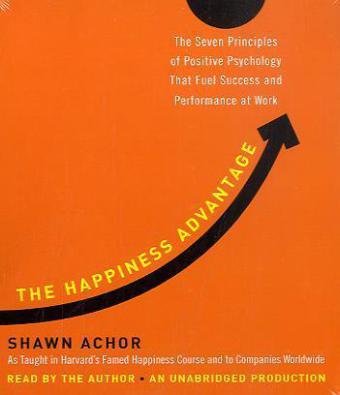

Our most commonly held formula for success is broken.
Conventional wisdom holds that if we work hard we will be more successful, and if we are more successful, then we’ll be happy. If we can just find that great job, win that next promotion, lose those five pounds, happiness will follow. But recent discoveries in the field of positive psychology have shown that this formula is actually backward: Happiness fuels success, not the other way around. When we are positive, our brains become more engaged, creative, motivated, energetic, resilient, and productive at work. This isn’t just an empty mantra. This discovery has been repeatedly borne out by rigorous research in psychology and neuroscience, management studies, and the bottom lines of organizations around the globe.
In The Happiness Advantage, Shawn Achor, who spent over a decade living, researching, and lecturing at Harvard University, draws on his own research—including one of the largest studies of happiness and potential at Harvard and others at companies like UBS and KPMG—to fix this broken formula. Using stories and case studies from his work with thousands of Fortune 500 executives in 42 countries, Achor explains how we can reprogram our brains to become more positive in order to gain a competitive edge at work.
Isolating seven practical, actionable principles that have been tried and tested everywhere from classrooms to boardrooms, stretching from Argentina to Zimbabwe, he shows us how we can capitalize on the Happiness Advantage to improve our performance and maximize our potential. Among the principles he outlines:
• The Tetris Effect: how to retrain our brains to spot patterns of possibility, so we can see—and seize—opportunities wherever we look.
• The Zorro Circle: how to channel our efforts on small, manageable goals, to gain the leverage to gradually conquer bigger and bigger ones.
• Social Investment: how to reap the dividends of investing in one of the greatest predictors of success and happiness—our social support network
A must-read for everyone trying to excel in a world of increasing workloads, stress, and negativity, The Happiness Advantage isn’t only about how to become happier at work. It’s about how to reap the benefits of a happier and more positive mind-set to achieve the extraordinary in our work and in our lives.
From the Hardcover edition.
Great information – and fun to read! I read a lot of business books. Most of them are filled with helpful information. Frankly, most of them are also a little on the dry. “The Happiness Advantage” is different. It is filled with fascinating research and great ideas, and it is also a hoot to read. I found myself laughing out loud as I read the book.Shawn Achor explains the latest research he and his colleagues in the field of positive psychology have conducted. The results are fascinating:1) Our brains work better when they are “happy.”2) There are concrete things we can do to make our brains “happier.”3) We can also overcome our inclination to procrastinate and put off these exercises. (I found this section to be particularly interesting since I am a procrastinator).4) When our brains are at “happy” that positivity will ripple out to others and can raise the productivity.Give this book a look. The research shows that we (and our colleagues at work) can be more productive. And, if we are “happier” our boss will also perceive us as more positive, trustworthy, sincere and successful. Wow! And who wouldn’t want to be happier at work – and at home?
Excellent and Unique I’ve read a lot of “happiness” books and frankly when I chose this book I was a little pessimistic about learning anything new. I couldn’t have been more wrong. This book, while building on a lot of prior research, is full of new insights and presentation that is refreshingly insightful and helpful. I learned a lot and it was a compelling and convincing read. There is a wealth of useful and practical takeaways from the material. The author works in the real world and doesn’t just write from a position in academia and thus has a lot more practical real-world experience than you often find in these types of books mostly written by psychology professors. I consider this one of the best I’ve read and I highly recommend it.