A good introduction to some little-known music I first heard this recording on an old scratchy LP in a college course on American music. Like most people, I was ignorant of the existence of ‘fuging tunes’, which are an odd and uniquely American blend of baroque counterpoint and homespun harmonies. This extended polyphony is often tacked onto the end of the homophonic chorales or hymns which constitute the standard fare of modern American Protestant church services (and are often boring and bland by comparison, in my opinion). What was in Europe a past-time for the elite became music for the masses in the New World: These tunes were sung not by choirs but by congregations, and proliferated in folk tunebooks such as the ‘Southern Harmony’, which still survives today.
It grows on you I’d like to echo what Mr. Cole wrote 6 years ago: the apparent youth of the singers is a benefit. This CD grows on you. It has staying power, variety, honesty, vigor… and sopranos that excel. Listen to what offsetting effect they have against the young basses on track 2, Chesterfield. Or the seductive tracks 5 and 13.The choir members are now pushing 50 years old. I would like to thank them for the pleasure and joyous renewal that they give so many years after these performances.
American and English Psalmody The music of American psalmodists such as Billings and Belcher, while it does represent some of the great achievements of the psalmody tradition, is not the whole of this tradition. The fuging tune and related music (anthems etc.) stem originally from English psalmody (the “West Gallery tradition”), the works of men such as William Tans’ur and Aaron Williams. They, their music and the people who sang it in England, as in the US, were very much not of the elite: they were of “the folk”, hence their folk music. Pieces by Tans’ur can be found, for those who are interested, in US psalmodies still in print, such as “Harmonia Sacra”
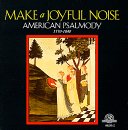

A good introduction to some little-known music I first heard this recording on an old scratchy LP in a college course on American music. Like most people, I was ignorant of the existence of ‘fuging tunes’, which are an odd and uniquely American blend of baroque counterpoint and homespun harmonies. This extended polyphony is often tacked onto the end of the homophonic chorales or hymns which constitute the standard fare of modern American Protestant church services (and are often boring and bland by comparison, in my opinion). What was in Europe a past-time for the elite became music for the masses in the New World: These tunes were sung not by choirs but by congregations, and proliferated in folk tunebooks such as the ‘Southern Harmony’, which still survives today.
It grows on you I’d like to echo what Mr. Cole wrote 6 years ago: the apparent youth of the singers is a benefit. This CD grows on you. It has staying power, variety, honesty, vigor… and sopranos that excel. Listen to what offsetting effect they have against the young basses on track 2, Chesterfield. Or the seductive tracks 5 and 13.The choir members are now pushing 50 years old. I would like to thank them for the pleasure and joyous renewal that they give so many years after these performances.
American and English Psalmody The music of American psalmodists such as Billings and Belcher, while it does represent some of the great achievements of the psalmody tradition, is not the whole of this tradition. The fuging tune and related music (anthems etc.) stem originally from English psalmody (the “West Gallery tradition”), the works of men such as William Tans’ur and Aaron Williams. They, their music and the people who sang it in England, as in the US, were very much not of the elite: they were of “the folk”, hence their folk music. Pieces by Tans’ur can be found, for those who are interested, in US psalmodies still in print, such as “Harmonia Sacra”