
0
0
0
0
0
0
0
0
0
or copy the link
Success through failure, calm through embracing anxiety—a totally original approach to self-help
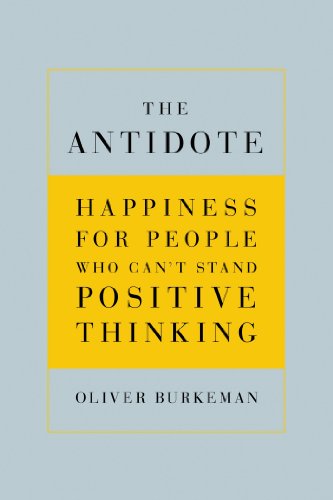
Self-help books don’t seem to work. Few of the many advantages of modern life seem capable of lifting our collective mood. Wealth—even if you can get it—doesn’t necessarily lead to happiness. Romance, family life, and work often bring as much stress as joy. We can’t even agree on what “happiness” means. So are we engaged in a futile pursuit? Or are we just going about it the wrong way?
Looking both east and west, in bulletins from the past and from far afield, Oliver Burkeman introduces us to an unusual group of people who share a single, surprising way of thinking about life. Whether experimental psychologists, terrorism experts, Buddhists, hardheaded business consultants, Greek philosophers, or modern-day gurus, they argue that in our personal lives, and in society at large, it’s our constant effort to be happy that is making us miserable. And that there is an alternative path to happiness and success that involves embracing failure, pessimism, insecurity, and uncertainty—the very things we spend our lives trying to avoid. Thought-provoking, counterintuitive, and ultimately uplifting, The Antidote is the intelligent person’s guide to understanding the much-misunderstood idea of happiness.
Amazon Best Books of the Month, November 2012: The you-can-do-it, life-is-one-big-smiley-face ethos of our contemporary culture has its value: Aggressive positivity helps many triumph over addiction, say, or build previously unimaginable businesses, even win elections and wars. But according to Oliver Burkeman, this relentless pursuit of happiness and success can also make us miserable. Exploring the dark side of the theories put forth by such icons as Norman Vincent Peale and Eckhart Tolle by looking to both ancient philosophy and current business theory, Burkeman–a feature writer for British newspaper The Guardian–offers up the counterintuitive idea that only by embracing and examining failure and loss and unhappiness will we become free of it. So in your next yoga class, try this: breathe deep, think unhappy thoughts–and feel your soul relax. –Sara Nelson
Self-help books don’t seem to work. Few of the many advantages of modern life seem capable of lifting our collective mood. Wealth—even if you can get it—doesn’t necessarily lead to happiness. Romance, family life, and work often bring as much stress as joy. We can’t even agree on what “happiness” means. So are we engaged in a futile pursuit? Or are we just going about it the wrong way?
Looking both east and west, in bulletins from the past and from far afield, Oliver Burkeman introduces us to an unusual group of people who share a single, surprising way of thinking about life. Whether experimental psychologists, terrorism experts, Buddhists, hardheaded business consultants, Greek philosophers, or modern-day gurus, they argue that in our personal lives, and in society at large, it’s our constant effort to be happy that is making us miserable. And that there is an alternative path to happiness and success that involves embracing failure, pessimism, insecurity, and uncertainty—the very things we spend our lives trying to avoid. Thought-provoking, counterintuitive, and ultimately uplifting, The Antidote is the intelligent person’s guide to understanding the much-misunderstood idea of happiness.
Superior self-help This was certainly a lot more enjoyable to read than most self-help books.I actually liked reading it which is a lot more than you say for the usual change your life, awaken the fear within, visualise success and ask the universe type books.The writing style is quite informal and discursive and despite the modesty of the author it is certainly a lot more rigorous and useful than the usual stuff from the snake oil salesmen. He recognises that what seems to work for him might not work for everyone.It probably isn’t an essential read if you do always look at his column in the Guardian though obviously in this book he gives each subject a more in depth treatment.
A self-help book for pessimists I really enjoyed reading this book. As a pessimist, I always thought that most of my ideas about life were not shared with mankind. The book showed me that some of my personal strategies are in fact quite common and proved effective also by others.If you hate self-help books I am sure that you will love reading this book, if you love them you SHOULD read this book.
Debby Downer was on to something. I am a sucker. Feature a writer on National Public Radio, and the interview is mildly entertaining, I will buy the book. I will also probably read it — the only question remaining: will I actually like it?The Antidote, for sure, is personally fascinating. I abhor positive thinking, gravitating instead toward reality. But I didn’t come by this easily. In my early 20′s, I became obsessed with all manner of self help, positive thinking and new age spirituality. I devoured (embarrassing) self help books, feeling temporarily inspired by them while making feeble attempts to put the words into practice. Inevitably, I’d feel like a failure for not being able to be perfect — or even slightly “better” than I was before; I’d feel consumed with anger and resentment, too, that my problems didn’t magically go away; that life wasn’t easier. It took me a LONG TIME to realize that my faux spirituality was primarily the cause of my dissatisfaction and pain.My actual problems were far less annoying than the books I was reading to solve them.I wish I’d read The Antidote 15 years ago.The Antidote travels familiar — to me, a junkie, at least — terrain. If you’ve ever read a book on buddhism (through a pop culture lens), for instance, much of this won’t be new: accept life as it is. But the context will; the author blends storytelling, cutting edge research, personal anecdote and wry humor into this compelling case for what he refers to as the negative path; the wisdom of the Stoics as a sane approach to life.I am torn as to how many stars to offer; for whatever reason, I wasn’t in love with the book as a whole. The author is certainly a talented writer, but I felt like the book went on and on. And on. This kind of thing, yes, is highly subjective, so take it with a grain of salt. To me, this book would have been a lot better had it been a lot shorter. I often feel this way about non-fiction books — that there’s a quota to fill. What’s wrong with lean and mean?(OK, OK: the book is not actually that long, so maybe it’s my attention span).It also bears mentioning that reading The Antidote is not actually the antidote for, really, anything: you actually have to live — which means accepting that life is hard and messy and sometimes ugly and awful; it means not constantly trying to escape it.But if you’re obsessed with The Secret, then you need this book. The Secret will not-so-secretly let you down, again and again. The Antidote contains actual valuable advice: there are no shortcuts, magical thinking is useless and, my favorite: a little negativity will make us happier.