
0
0
0
0
0
0
0
0
0
or copy the link
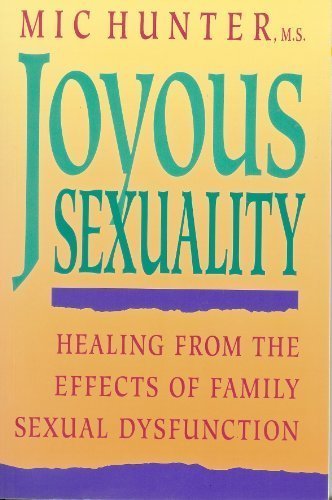
This book was written for those raised in families that were negative about sex, overvalued sex, or were sexually shut down. Dr. Hunter describes ten characteristics of these families and how adult relationship are negatively affected by these early experiences. More importantly he discusses practical methods for making meaningful changes to improve the reader’s sexuality and intimacy skills. The focus is on obtaining healthy sexuality and reducing shame and fear related to sex and relationships.
Oustanding Insight into sexually dysfunctional childhood…. Amazing reading… Joyous Sexuality has captured the essence of sexual dysfunction problems and how they relate to adult life. Mic Hunter has simply, but eloquently, shown how successful recovery can be achieved if one will only follow and adhere to the 12 step program outlined in the book. He has also provided workspace to allow the reader to participate which is necessary for successful recovery. I recommend this book to anyone with any form of sexual addiction or relationship difficulties.
This is a must read Mic Hunter’s book, from 1992, is still relevant and excellent. As a clinician, I use this book with a wide variety of clients – even those who have not experienced sexual trauma. Since we live in such a sexually dysfunctional culture, Hunter’s book offers an excellent way to process our beliefs and to help our society move toward healthy and vibrant sexuality/sensuality that is also in alignment with our true values.Hunter does an excellent job in not hoisting his beliefs upon the reader, but assisting the reader in exploring his/her experiences and teachings (covert and overt) about sex, relationships, sexuality and their body.Hopefully, this book will become available again. It will remain on my top 10 list!
Book Review of “Joyous Sexuality: Healing from the Effects of Family Sexual Dysfunction”; Review by Michele Babcock-Nice Dr. Mic Hunter has a wealth of knowledge and experience in psychologically-treating individuals who have experienced sexual trauma, sexual abuse, sexual dysfunction, and addictions. He believes in the positive influence and effects of people practicing The Twelve Steps of Alcoholics Anonymous, as well as adapting them to psychologically-based issues in addition to alcoholism.In his book, “Joyous Sexuality: Healing from the Effects of Family Sexual Dysfunction,” Dr. Hunter has again applied The Twelve Steps, as well as many valuable, beneficial, and thoughtful workbook-style questions in the treatment and recognition of family sexual dysfunction and individual sexual dysfunction as a result of the former. Dr. Hunter identifies and describes family sexual dysfunction, including many different styles and characteristics of it that are helpful for readers to know, understand, and reflect upon.Dr. Hunter goes further by identifying and describing adult child issues related to family sexual dysfunction, unhealthy and healthy aspects of adult sexuality, and applying The Twelve Steps to family sexual dysfunction – as an individual – as a method of recovery. He not only identifies The Twelve Steps for use in conjunction with recovery from family sexual dysfunction, but also describes how they apply to recovery and provides personalized workbook questions for individuals to answer in an effort to identify, recognize, contemplate, and recover from past sexually dysfunctional experiences.Dysfunction prevents the fulfillment of needs in a reasonable manner, and may include extremes of behavior. This also applies to families. In a sexually dysfunction family, there are attitudes, behaviors, or other interactions and communications that have a negative affect on the family members’ sexuality (p. 1). Rather than enjoying sexuality, “they end up being hurt by” it (p. 1).Dr. Hunter identifies and describes “three basic extremes [that] are common in sexually dysfunction families: the overvaluation of sex, negative attitudes about sex, and sexual shutdown” (p. 2). In families that overvalue sex, “sex is the most important thing in life” (p. 2). People in such families have “sexuality as the predominant focus of most interactions,” and “they sexualize their emotions” (p. 2).In sex-negative families, “sex is something to be feared, because it is seen to be dangerous, perhaps even evil” (p. 4). Dr. Hunter shares that such families may “enforce rigid rules about sexual behavior,” and when a person violates those rules, he or she feels unworthy and ashamed (p. 4). In the sexually shut-down family, “there is a nearly phobic response” to sex (p. 5). People in such families are hard at work in repressing their sexuality, ignoring children’s sexual development, and pretending not to notice sexual develop changes (p. 5). There are also families that combine the dysfunctional styles.Members of the adult self-help group, Adult Children of Sexual Dysfunction (ACSD), identified ten main characteristics related to family sexual dysfunction when they were young, such characteristics affecting their behavior. Some of these characteristics include experiencing confusion or shame about sexuality, a lack of healthy or nourishing touch, and the experience of difficulty in establishing relationships that are intimate (p. 8).Dr. Hunter goes on to identify, describe, and discuss each of the ten characteristics pinpointed by ACSD and provide his helpful, reflective workbook questions that personally assist individual readers in remembering and recognizing past sexual attitudes and/or experiences within their families. A few of Dr. Hunter’s questions in relation to these described characteristics include: “When you think about the other gender, how do you feel?” (p. 24); “How do you react now to being touched by others?” (p. 37); and “What relationship patterns have you noticed in your life” (p. 47).Importantly in regard to the tenth characteristic of confusing sex with emotions, Dr. Hunter identifies and describes different types of intimacy, including physical, sexual, mental, emotional, and spiritual. One of the results of the tenth characteristic may be that people “sometimes leave groups or end friendships when they start to grow close” (p. 71). Also, those who sexually abuse children may misunderstand sexuality and sexual boundaries by stating that they are being intimate with the children (p. 71).Dr. Hunter states that “perhaps the most destructive consequence of living as a child in a sexually dysfunctional family is the development of a shame-based identity” (p. 73). Even when the child grows into adulthood, he or she continues to be ashamed. Such identities stem from relationships that are abusive or neglectful (p. 73). In order to heal from the affects of such experiences, Dr. Hunter states that “safe, nurturing…