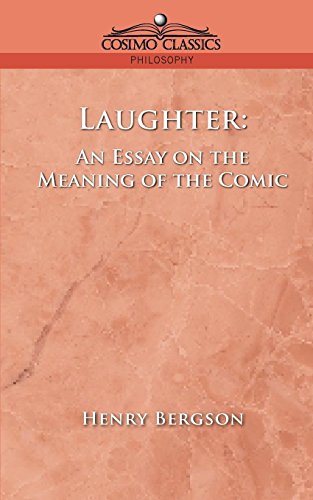

Philosopher Henri Bergson was best known for his works on intuition, consciousness, time, and creative evolution. His writings included Matter and Memory, An Introduction to Metaphysics, and Creative Evolution, and he was said to have influenced thinkers such as Marcel Proust, William James, Santayana, and Martin Heidegger. After a career as a professor at the College de France, Bergson turned to diplomacy and writing, and was deeply involved with the League of Nations. While he won the Nobel Prize in literature in 1927, for a time his writings were shunned by devout Catholics.
In Laughter, Bergson considers the meaning of the comic element in forms and movements, situations, words, and character. He regards the comic as a living thing with a logic of its own. It requires an absence of feeling, “something like a momentary anesthesia of the heart. Its appeal is to intelligence, pure and simple.” It must have a social signification; it must be within the human realm. Above all, since laughter inspires fear, the comic is seen as a check on our more eccentric impulses. Bergson wrote: “In laughter we always find an unavowed intention to humiliate and consequently to correct our neighbour.”Clem Kadiddlehopper wore a funny hat. Even animals other than humans seem to laugh, because they, too, possess emotions. And sometimes, when you’re by yourself, you just start giggling for no reason. But that’s not funny. As Henri Bergson, proto-existentialist French philosopher and author of Laughter: An Essay on the Meaning of the Comic, would say, you can stop laughing now. We must rethink what tickles us. For Bergson, laughter is a purely intellectual response that serves the social purpose of assuaging discomfort over the unaccustomed and unexpected. We chuckle at Lucy attempting to wrap the bonbons speeding by on a candy-factory conveyor belt because she’s stuck in one place, performing the same task over and over, and failing; we hope that in similar situations we could be more flexible. Bergson recaps: “Rigidity is the comic, and laughter is its corrective.”
Bergson’s thinking typifies a peculiarly Gallic tendency to rationalize the apparently ephemeral and subjective (in this case, humor), discussing it in exquisitely rarefied language in order to assert that which defies common sense (a funny hat is not funny, laughter expresses no emotion, no one laughs alone) but partakes nonetheless of a logical inevitability. Laughter, first published in 1911, clearly draws upon the early years of European modernism, yet also prefigures the movement in some ways. In recognizing the comic as it embodies itself in a “rigid,” absentminded person, locked into repetitious, socially awkward behavior, Bergson–even as he looks backward, primarily to Molière–seems to be spawning the sophisticated visual and physical comedy of Chaplin, Keaton, and Lloyd; the transformation of Léger’s figures into anthropoid machines; and Nijinsky’s starring role in Stravinsky’s satirical clockwork ballet Pétrouchka.
This little book resurrects a British translation that has long been out of print. While Laughter won’t quite explain why the French love Jerry Lewis, or keep you in stitches, it’s a bracing read that will make you think twice about laughing the next time someone stumbles into a lamppost. –Robert Burns Neveldine Philosopher Henri Bergson was best known for his works on intuition, consciousness, time, and creative evolution. His writings included Matter and Memory, An Introduction to Metaphysics, and Creative Evolution, and he was said to have influenced thinkers such as Marcel Proust, William James, Santayana, and Martin Heidegger. After a career as a professor at the College de France, Bergson turned to diplomacy and writing, and was deeply involved with the League of Nations. While he won the Nobel Prize in literature in 1927, for a time his writings were shunned by devout Catholics.
In Laughter, Bergson considers the meaning of the comic element in forms and movements, situations, words, and character. He regards the comic as a living thing with a logic of its own. It requires an absence of feeling, “something like a momentary anesthesia of the heart. Its appeal is to intelligence, pure and simple.” It must have a social signification; it must be within the human realm. Above all, since laughter inspires fear, the comic is seen as a check on our more eccentric impulses. Bergson wrote: “In laughter we always find an unavowed intention to humiliate and consequently to correct our neighbour.”
Enormously provocative
A bit dated. Somewhat incomplete. Astoundingly insightful
Still profound after all these years