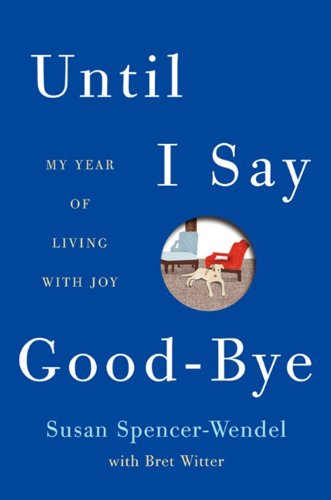

Susan Spencer-Wendel’s Until I Say Good-Bye: My Year of Living with Joy is a moving and inspirational memoir by a woman who makes the most of her final days after discovering she has amyotrophic lateral sclerosis (ALS).
After Spencer-Wendel, a celebrated journalist at the Palm Beach Post, learns of her diagnosis of ALS, more commonly known as Lou Gehrig’s disease, she embarks on several adventures, traveling toseveral countries and sharing special experiences with loved ones. One trip takes Spencer-Wendel and her fourteen-year-old daughter, Marina, to New York City’s Kleinfeld’s Bridal to shop for Marina’s future wedding dress—an occasion that Susan knows she will never see.
Co-written with Bret Witter, Until I Say Good-Bye is Spencer-Wendel’s account of living a full life with humor, courage, and love, but also accepting death with grace and dignity. It’s a celebration of life, a look into the face of death, and the effort we must make to show the people that we love and care about how very much they mean to us.
Author One-on-One: Cokie Roberts and Susan Spencer-Wendel
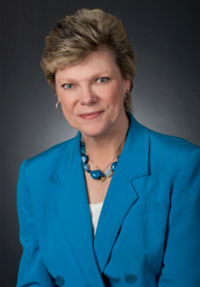
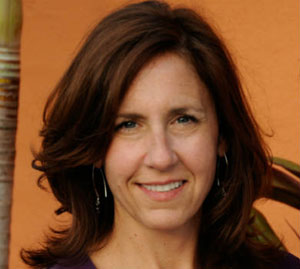
Cokie Roberts is a political commentator for ABC News and the author of We Are Our Mothers’ Daughters.
Cokie Roberts: You are a journalist. Has writing about ALS helped you deal with it? How in general has writing shaped you?
Susan Spencer-Wendel: As a journalist, I am a truth teller, no matter how uncomfortable it may be. There is no pretending. This helped me a great deal to recognize the reality of ALS. I have written thousands of stories as a newspaper reporter, which prepared me. One, because I’ve seen all kinds of tragedy in my career. I realized bad things happen to good people on quite a regular basis. And, two, because I knew how to distill events into stories. Writing is wonderful because it forces us to crystallize our jumbled thoughts via words.
CR: When it came to literally writing this book you faced some physical challenges. Can you tell us how you ended up writing the book?
SS: With ALS, the tiniest muscles fail first. Like the ones in your fingers. I was no longer able to type on a regular keyboard. I did not have the strength in my finger to press the keys. So I began on an iPad. Typing each letter on the touchscreen. Then my hand began to drag across the screen. Right about then, I landed a book deal, which was a tremendous incentive to improvise. I had always used the notes function on my iPhone to jot things down. Phrasing which came to me, grocery lists, or on trips, when getting out a laptop was not possible. I loved knowing that it was always there. I’d write anywhere and everywhere. As I waited for the children at music lessons, etc. I held the phone in my left hand. Propped it flat atop my curled fingers, and used my right thumb to type 89,000 words in four months. One letter at a time. Such is the power of desire. On the phone, I can only see 7 lines at a time. Which actually is a blessing. To hyperfocus on the sentence at hand. Active verbs. Few adjectives. I had an outline, a recipe, to create the book. An absolute must for a book, I believe. Bret Witter helped so with that. He saw the full picture, the book, when I saw only a tiny screen. He reminded me where I was at when I was absolutely awash in memories.
CR: You write about looking at life joyfully. Is that what you want readers to take away from this book—that even in rough situations they can experience great joy?
SS: Of course. I am not trying to be Dr. Phil, but I do hope it will inspire people to set their intention to do so. And make them feel lucky…
CR: Is that message especially important for your children to hear?
SS: Absolutely. I hope they learn “My ma did not feel sorry for herself. So neither will I.”
CR: Many people with your diagnosis would either crawl into a cave or go from doctor to doctor trying to survive a little longer. You chose not to do that. Why?
SS:The problem with a cave is it has no windows. And the problem with knocking on umpteen doctor doors is there is nothing behind the door. There is no cure. Period. I’m realistic. A cure, a drug, won’t come in time for me. I am not giving up. I am accepting. There is a difference. It was a chain reaction in my mind. I am not sure what set off what. Like an orchid lying fallow, neglected in my side yard, and one day a bloom appears. The factors were just there. Nature itself was a factor for me. Nature is so perfect. Photosynthesis. Pollination. Conception (Huge smile!). The monarch butterflies which migrate thousands of miles to Mexico to convene there. The rainforest canopy, where ants can fly so they don’t fall to the ground. The laws of physics. That objects in motion have energy. I don’t have the will or motion and, ergo, the energy to fight nature, beautiful nature. Also a major factor is my husband, John. I so want him to have a chance at another life. Not saddled with the weight of an invalid wife. Desire is root of all suffering, I believe. To want something you can’t have. The cure is to not want it. I practice not wanting a cure, preparing to die. Choosing the path of least resistance. Going gracefully into the night.
What about your children??? People wonder.
Remember, they are MY children. I know what is best for them. I know that they are well-provided for. I know the love that surrounds them. I know the more gracefully I accept things, so too may they. I know they have my strength. I have not wavered once in these beliefs.
CR: Your therapy—travel—was not an easy one to accomplish. You had to go through tough things physically in order to see some of those faraway places. Were the trips worth the sometimes scary situations you found yourself in?
SS: Absolutely. I would not use the word “scary” though. We weren’t swimming with sharks. When I was exhausted at the bottom of the stairs at Wreck Beach, I wasn’t scared. More just worried. I adore traveling. So it was natural to go, not difficult to accomplish at all. But not without the help of John, Nancy and Steph. If they sound like saints in the book, that’s cause they are saints.
I turned the pages, slack-jawed, in awe. The sickest she’d ever been was “after I ate a bad chicken sandwich in South America.”And now her left hand doesn’t work.Susan Spencer-Wendel lives in reality — she’s a veteran journalist for the Palm Beach Post.It doesn’t take her long to figure out she has amyotrophic lateral sclerosis (ALS): Lou Gehrig’s disease.She’s married, with three young kids.She’s 44 years old.She has a year to live.And not a pleasant year. Muscles weaken. Walking becomes impossible. Then swallowing becomes a challenge. Then breathing. In the end, the patient finds herself trapped in a non-functioning body, waiting to die.HarperCollins paid $2 million to publish “Until I Say Good-Bye” and Universal paid another $2 million for the movie rights, and neither did it so they could present a chronicle of death at work. Their reason is right in the subtitle: “My Year of Living With Joy.” Because that was her resolution. Not to commit suicide before she couldn’t. Not to despair. But to spend her time wisely:”To take the trips I’d longed to take and experience each pleasure I’d longed for as well.To organize what I was leaving behind.To plant a garden of memories for my family to bloom in their futures.Lou Gehrig was an athlete. ALS took his talent immediately.But I was a writer. ALS could curl my fingers and weaken my body, but it could not take my talent.I had time to express myself. To build a place of my own with comfy chairs, where I could think and write and sit with friends. Where I could wander through my own garden of memories and write them down.A wandering that became, beyond my every fantasy, this book.A book not about illness and despair, but a record of my final wonderful year.A gift to my children so they would understand who I was and learn the way to live after tragedy:With joy.And without fear.If Lou Gehrig could feel lucky, then so could I.So should I.”It’s hard to know what to say about this book. Really, it’s beyond criticism. To write anything negative isn’t to comment on its literary merits, it’s to dish Susan Spencer-Wendel’s life. And you can’t. All you can do — if you can read this book at all — is to turn the pages, slack-jawed, in awe at her insistence on having powerful, individual experiences with her husband, her kids, her sister, her best friend and the birth mother she’s only recently met. It seems impossible, but she gets around: the Northern Lights, Budapest, swimming with dolphins.As I read this book, I discovered something unnerving: I was reading two books. One is the book she typed on an iPhone with her right thumb, the book Bret Witter then polished for her. The other is my book, the one I’d write if I knew I had a year to live. I’d like to think I’d have a short, private cry, then get on with my life. Not as a stoic, but because I understood that we’re all dying, and the only difference between everybody else and me was that I more or less knew when. I’d like to think that’s some kind of advantage.And I’d like to think Susan Spencer-Wendel’s final wish would be mine: “To make people laugh and cry and hug their children and joke with their friends and dwell in how wonderful it is to be alive.”How utterly soppy. How totally terrific.
A poignant, funny celebration of life Susan Spencer-Wendel was a busy mom, wife and courthouse reporter at The Palm Beach Post when she was diagnosed with amyotrophic lateral sclerosis (Lou Gehrig’s disease). Instead of folding up and planning a funeral, she bucks up and plans trips, memories for her family and friends.She visits Hungary, Cyprus, the Yukon, and New York City, each trip with a goal. She takes each of her three children on a special trip they chose. She also has a beautiful chickee hut built in her backyard, where she writes the book, entirely with her right thumb on her iPhone.The book is more funny than sad. She shows us how much one person can accomplish in the face of life-changing news, and how important it is to show the people around us how much we love them.