
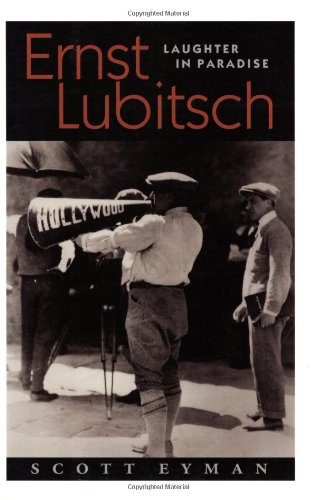
When movie lovers speak of the “Lubitsch touch,” they refer to a singular sense of style and taste, humor and humanity, that suffused the films of one of Hollywood’s greatest directors. In this first ever full-length biography of Ernst Lubitsch, Scott Eyman takes readers behind the scenes of such classic films as Trouble in Paradise (1932), The Merry Widow (1934), Bluebeard’s Eighth Wife (1938), Ninotchka (1939), The Shop around the Corner (1940), To Be or Not to Be (1942), and Heaven Can Wait (1943), which together constitute one of the most important and influential bodies of work in Hollywood. Eyman examines both the films Lubitsch crafted and the life he lived—his great successes and his overwhelming anxieties—to create an indelible portrait of Hollywood’s Golden Age and one of its most respected artists.
Ernst Lubitsch: Laughter in Paradise
Pinned on February 14, 2013 at 10:51 pm by Leslie Arbour
0
0
0
0
0
0
0
0
0
or copy the link
Comments
A very good biography ! This biography of the geat Ernst LUBITSCH is really better than the overrated book “THE LUBITSCH TOUCH” by WEINBERG. It is an alive book by a writer who really admire the director and the man. It also gives some good reviews and information about Lubitsch’s geat films. My only complain is that the autor doesn’t really develop the German period (which is still underrated and considered as “vulgar” – “thanks” to the famous critic Lotte EISNER), like all the books about Lubitsch, it focuses on the masterpierces of the 30′s and the 40′s (the most known period and the best of course). But buy it, if you want to know more about LUBITSCH/the man (and prefer this book to Weinberg’s one). About LUBITSCH/the director, buy the excellent book by S. RAPHAELSON “3 screen comedies” (if you can find it !) and J. HARVEY’s “American comedies : from Lubitsch to Sturges”.
Wow! A biography about my favorite director, by my favorite film biographer, which provides lots of satisfying detail about Lubitsch’s background, film training, early theater efforts as an actor, writer and director, romantic entanglements, and best of all his Hollywood years when Lubitsch gave his magic “touch” to some of my favorite films (“Shop Around the Corner,” “Ninotchka,” “Heaven Can Wait,” “Cluny Brown,” etc).Eyman describes Lubitsch as “giving great love,” to the family of his first wife and her two sons. Lubitsch treated her sons as his own, and showered her with all of the percs her position as the wife of a great Hollywood director warranted. Once said wife cheated on him with his colleague, and humiliated him, he was also capable of turning his back on her, and her sons, who meant so much to him, virtually never acknowledging them again. So Lubitsch, who portrayed infidelity as something to throw away carelessly in films (think the “Smiling Lieutenant” in which the corpulent king only discovers his queen is cheating on him with a slim, handsome, young lieutenant when he accidentally tries to put on the lover’s belt and sword) can’t tolerate the thought of a similar situation going on in his own bedroom. Eyman also describes a man who, although ethnically unmistakable as a european Jew, is only attracted to patrician-looking women who didn’t necessarily make him happy. One person he loved unreservedly was his little daughter Nicola, from his second marriage, which also failed.I was interested in the reason nazis chose Lubitsch as the object of their racial scorn, above all other famous German Jews, and Eyman explains that this was due to Lubitsch’s own choice to develop and film himself portraying a comic Jewish character in his early films who looks and behaves in a manner which ethnic Germans found offensive, and very undesirable to expose to German society as a whole.Lubitsch had a wry and realistic way of looking at life such that he could understand and deal with actresses who could be most unappealing (think Miriam Hopkins and Jennifer Jones), but from whom Lubitsch extracts the most charming performances of their careers. The director’s wry wit also lead him to depict the situations in his films with the “Lubitsch touch” by portraying the ironies and shocks of mundane life such that the audience could discover and identify with the situations faced by Lubitsch’s characters by being drawn into their individual points of view. This is a great book about a director whose life and work has not been well delineated (possibly because it is so ephemeral) until now.