
Foreword by Wray Herbert
Author of On Second Thought: Outsmarting Your Mind’s Hardwired Habits
Former editor in chief of Psychology Today
Regular contributor to Science, Scientific American, and Science News
Why do we routinely choose options that don’t meet our short-term needs and undermine our long-term goals? Why do we willingly expose ourselves to temptations that undercut our hard-fought progress to overcome addictions? Why are we prone to assigning meaning to statistically common coincidences? Why do we insist we’re right even when evidence contradicts us?
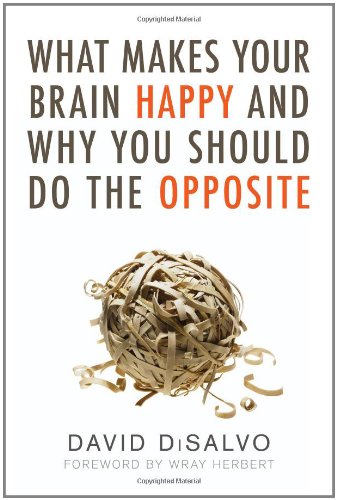
In What Makes Your Brain Happy and Why You Should Do the Opposite, science writer David DiSalvo reveals a remarkable paradox: what your brain wants is frequently not what your brain needs. In fact, much of what makes our brains “happy” leads to errors, biases, and distortions, which make getting out of our own way extremely difficult. DiSalvo’s search includes forays into evolutionary and social psychology, cognitive science, neurology, and even marketing and economics—as well as interviews with many of the top thinkers in psychology and neuroscience today.
From this research-based platform, DiSalvo draws out insights that we can use to identify our brains’ foibles and turn our awareness into edifying action. Ultimately, DiSalvo argues, the research does not serve up ready-made answers, but provides us with actionable clues for overcoming the plight of our advanced brains and, consequently, living more fulfilled lives.
Decent cognitive psych sampler. This is another book in the increasingly popular genre of pop cognitive psychology. These books usually take the following approach:1) Author reads tons of studies revealing brain quirks, failures, and surprising behavior.2) Author attempts to tie some of these into related themes (Think Malcolm Gladwell’s “Blink”).3) Author discusses the “lessons learned” from these studies.”What Makes Your Brain Happy” is no exception. The title refers to the brains tendency to fall into common, comfortable behavior patterns, occasionally to our detriment. Subjects like confirmation bias, framing, and mental heuristics and all discussed via various studies, anecdotes, and thought experiments. He also wades into territory common to many books on the subject of happiness including habituation, buyer’s remorse, narcissism, and loneliness. To fans of cognitive psych and behavioral economics, most of this material will be familiar. To the uninitiated, this is a decent introduction. DiSalvo positions this book as a scientific alternative to the self-help genre which he regards as frequently built on false promises. He takes a couple jabs at the self-help industry early on (you’re not suddenly seeing more Chanel handbags because the cosmos are responding to your “dream board” but rather because you’ve keyed yourself into looking for them) but this book is really about examining studies and trying to wring out some lessons that we can apply to our own life.Does he succeed? Yes and no. At the end of the book he distills the material covered into 50 “lessons” to apply to our own lives. They range from reasonable and actionable (let others know about your goals to enhance motivation, make goals tangible and measurable) to the vague and difficult to implement (don’t always trust common sense, know when to engage heuristic override) to the simply observational (it’s difficult to tell what we’d do in an emotionally charged and time constrained situation). DiSalvo acknowledges that many brain failures are due to “bad wiring” which makes altering our behavior notoriously difficult. He broadly promotes metacognition, that is, thinking about our own thinking, as a means of identifying bias and irrational behavior. I definitely agree and think reading books of this type helps.My main complaint is that the book is extremely broad and scattershot. It starts off as a nice breezy read, full of interesting, illustrative anecdotes, but it starts to drag toward the middle, with study after study and no common thread. It started to feel like reading 100 back to back magazine articles rather than a cohesive whole. The lessons may be valid, but 50 is so overwhelming that none of them are really “driven home”. After closing this book I didn’t feel immediately compelled to implement any changes in my life or way of thinking (and not for lack of openness).I debated as to whether to give this 3 or 4 stars. It’s not a bad book, but I didn’t think it did anything well enough to warrant a higher rating, especially when there are so many other good books like Kahneman’s “Thinking Fast and Slow” out there.
One of the Best on the Topic I’ve read many books on the topic of cognitive bias and this rates one of the best for the general reader. I’m endlessly fascinated by the topic and can’t seem to stop reading these books even though there isn’t a lot new in most of them. They all keep saying the same thing and I’m getting a little tired of it.So I was quite surprised when this one seemed a little different. It does an excellent job at explaining the issues and it is one of the few books in this area that devotes a reasonable amount of space to what you can actually do to avoid the problems. The author devotes one whole chapter at the end to 50 techniques to help you avoid your brain faults and he scatters other advice through most of the rest of the book.The book is organized well, it is very clear in its explanation, and it reads easily and quickly. It kept my attention throughout. There is an excellent resources section at the end of the book which describes a large number of related books and blogs. That resource list alone is probably worth the price of the book.To top it off this book has Amazon’s “Look Inside!” feature that let’s you preview before you buy. Well done and highly recommended.