Sick, twisted, disturbing – but you can’t stop watching it There have been few times that I’ve sat for more than two hours, intently watching a film, screaming “I hate this movie!” as the credits begin to roll, but then realize that I don’t hate it at all. In fact, I don’t know if that has ever happened before, but last night, after the final, revolting line of Todd Solondz’s 1998 shocker Happiness, I did just that, and probably because I couldn’t bring myself to admit I liked it. It’s a movie that deals with wildly perverse subject matter, contains not a truly likeable character in the whole bunch, and doesn’t even bother to show the consequences of the horrible actions for any of its transgressors. If there is a poster-child movie for complete and total amorality, Happiness is the one. But I liked it, and that scares me. Joy (Jane Adams) has absolutely nothing in common with her name; her sister Helen (Lara Flynn Boyle) is a sultry, narcissistic author who wants the experience of being raped to make her writing authentic; other sister Trish (Cynthia Stevenson) is married to Dr. Bill Maplewood (Dylan Baker) and has three kids. Dr. Bill is a pedophile who pleasures himself to teen magazines in the backseat of his car and has dreams of murdering strangers in a park; Dr. Bill’s strangest patient, Allen (Phillip Seymour Hoffman), makes obscene phone calls and has an inventive way of pasting postcards to the wall; Allen’s neighbor, Kristina (Camryn Manheim), is in love with him but has her own disgusting little story to hide. Nearly every character has a dark side, the only truly ‘good’ one (Joy) seems to get everything wrong, and the one romance that blooms during the movie has a twinge of wrongness to it. The movie is a strung-together mosaic of perpetual sadness, the search for the remedy, and the stomach-churning causes of it all; and yet, between my gasps of shock and uneasiness, I can’t say there’s a boring moment in the film. The most difficult character in the movie to even look at is, obviously, Dr. Maplewood. Dylan Baker has that glaring gaze that could boil cheese, and it takes on an especially creepy tone when he’s gazing longingly at his son’s baseball teammate at a little league game. But, believe it or not, Solondz injects comedy even into something as despicable as the Maplewood situation. The film’s most controversial scene, involving drugged chocolate sundaes and a tuna salad sandwich, is god-awfully wrong…but had me thinking about that great moment in Psycho when Marion Crane’s car stops as it’s sinking into the swamp and Norman Bates panics for a moment. And laughing, too. This element of the plot angered many people in 1998 and is still something to wrestle to this day; why make Maplewood a three-dimensional man with real emotions when all he is is a predatory pederast? Because it wouldn’t be interesting, it wouldn’t be watchable, if he wasn’t. Take a climactic scene in the film, that must deal with the truths of Maplewood’s actions: Solondz creates a scene that is brutally honest and deeply disturbing, but still grounded in the poignancy of a father-son discussion. I found myself alternating between pure puzzlement and a desire to turn the movie off in its first, love-it-or-leave-it act. But Solondz is in such control of his connecting plot strands that he makes the links quickly, moves in and out of them with ease, and even allows for unexpectedly moving moments to occur. The great subplot of the film is with Phillip Seymour Hoffman and Camryn Manheim. In some ways, it sums up the entire theme of the film, while having all of Happiness’ strengths and weaknesses. Solondz gives us a great scene where the two come together, dancing to a pop song in a bar, and it’s a brief moment of euphoria and sweetness despite the depravity that surrounds and underscores it. Of course, for some viewers, the hidden lives of even Allen and Kristina may be too strange to merit caring about. I struggled with it, too. Solondz made a very good film a few years ago, Storytelling (rent it), that contains similarly risque subject matter but ends up being too facile in the resolutions of the two vignettes that comprise the film. His breakthrough movie, Welcome to the Dollhouse, came before Happiness, and takes a similarly piercing look at real life but is bogged down too much in its deadpan humor and relentless punishment of its protagonist. Happiness straddles the shortcomings of both of those films, neither offering a simple resolution to its problems or being too strange to the point where unrealism sets in. It is real, it is complex, and it’s also deeply disturbing and maybe morally offensive. I’m also known for not really caring about the morality of a movie, so maybe that’s why I was never bored or too offended at any time. The best line in Happiness comes toward the very end, when the sisters and their parents are sitting around talking about a grisly New Jersey murder, involving dismemberment and…

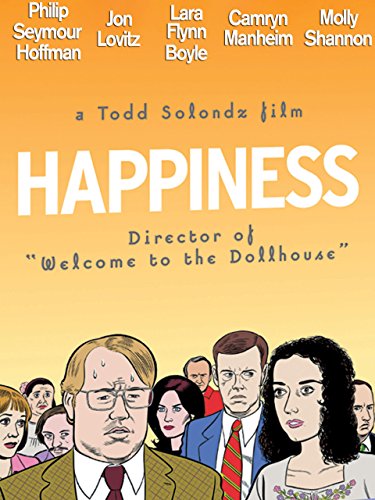
Sick, twisted, disturbing – but you can’t stop watching it There have been few times that I’ve sat for more than two hours, intently watching a film, screaming “I hate this movie!” as the credits begin to roll, but then realize that I don’t hate it at all. In fact, I don’t know if that has ever happened before, but last night, after the final, revolting line of Todd Solondz’s 1998 shocker Happiness, I did just that, and probably because I couldn’t bring myself to admit I liked it. It’s a movie that deals with wildly perverse subject matter, contains not a truly likeable character in the whole bunch, and doesn’t even bother to show the consequences of the horrible actions for any of its transgressors. If there is a poster-child movie for complete and total amorality, Happiness is the one. But I liked it, and that scares me. Joy (Jane Adams) has absolutely nothing in common with her name; her sister Helen (Lara Flynn Boyle) is a sultry, narcissistic author who wants the experience of being raped to make her writing authentic; other sister Trish (Cynthia Stevenson) is married to Dr. Bill Maplewood (Dylan Baker) and has three kids. Dr. Bill is a pedophile who pleasures himself to teen magazines in the backseat of his car and has dreams of murdering strangers in a park; Dr. Bill’s strangest patient, Allen (Phillip Seymour Hoffman), makes obscene phone calls and has an inventive way of pasting postcards to the wall; Allen’s neighbor, Kristina (Camryn Manheim), is in love with him but has her own disgusting little story to hide. Nearly every character has a dark side, the only truly ‘good’ one (Joy) seems to get everything wrong, and the one romance that blooms during the movie has a twinge of wrongness to it. The movie is a strung-together mosaic of perpetual sadness, the search for the remedy, and the stomach-churning causes of it all; and yet, between my gasps of shock and uneasiness, I can’t say there’s a boring moment in the film. The most difficult character in the movie to even look at is, obviously, Dr. Maplewood. Dylan Baker has that glaring gaze that could boil cheese, and it takes on an especially creepy tone when he’s gazing longingly at his son’s baseball teammate at a little league game. But, believe it or not, Solondz injects comedy even into something as despicable as the Maplewood situation. The film’s most controversial scene, involving drugged chocolate sundaes and a tuna salad sandwich, is god-awfully wrong…but had me thinking about that great moment in Psycho when Marion Crane’s car stops as it’s sinking into the swamp and Norman Bates panics for a moment. And laughing, too. This element of the plot angered many people in 1998 and is still something to wrestle to this day; why make Maplewood a three-dimensional man with real emotions when all he is is a predatory pederast? Because it wouldn’t be interesting, it wouldn’t be watchable, if he wasn’t. Take a climactic scene in the film, that must deal with the truths of Maplewood’s actions: Solondz creates a scene that is brutally honest and deeply disturbing, but still grounded in the poignancy of a father-son discussion. I found myself alternating between pure puzzlement and a desire to turn the movie off in its first, love-it-or-leave-it act. But Solondz is in such control of his connecting plot strands that he makes the links quickly, moves in and out of them with ease, and even allows for unexpectedly moving moments to occur. The great subplot of the film is with Phillip Seymour Hoffman and Camryn Manheim. In some ways, it sums up the entire theme of the film, while having all of Happiness’ strengths and weaknesses. Solondz gives us a great scene where the two come together, dancing to a pop song in a bar, and it’s a brief moment of euphoria and sweetness despite the depravity that surrounds and underscores it. Of course, for some viewers, the hidden lives of even Allen and Kristina may be too strange to merit caring about. I struggled with it, too. Solondz made a very good film a few years ago, Storytelling (rent it), that contains similarly risque subject matter but ends up being too facile in the resolutions of the two vignettes that comprise the film. His breakthrough movie, Welcome to the Dollhouse, came before Happiness, and takes a similarly piercing look at real life but is bogged down too much in its deadpan humor and relentless punishment of its protagonist. Happiness straddles the shortcomings of both of those films, neither offering a simple resolution to its problems or being too strange to the point where unrealism sets in. It is real, it is complex, and it’s also deeply disturbing and maybe morally offensive. I’m also known for not really caring about the morality of a movie, so maybe that’s why I was never bored or too offended at any time. The best line in Happiness comes toward the very end, when the sisters and their parents are sitting around talking about a grisly New Jersey murder, involving dismemberment and…
Get Out Your Addressbook and See for Yourself 0
Represents everything good about indepent film 0