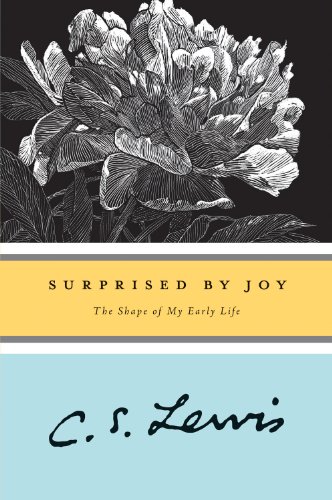

“A young man who wishes to remain a sound Atheist cannot be too careful of his reading. There are traps everywhere . . . God is, if I may say it, very unscrupulous.”
This book is not an autobiography. It is not a confession. It is, however, certainly one of the most beautiful and insightful accounts of a person coming to faith. In this case, that person is C.S. Lewis and his path takes us from a childhood in Belfast through the loss of his mother, to boarding school and a youthful atheism in England, to the trenches of World War I, and then to life at Oxford, where he studied, read, and, ultimately, reasoned his way back to God. It is perhaps this aspect of Surprised by Joy that we—believers and nonbelievers—find most compelling and meaningful; Lewis was searching for joy, for an elusive and momentary sensation of glorious yearning, but he found it, and spiritual life, through the use of reason.
In this highly personal, thoughtful, intelligent memoir, Lewis guides us toward joy and toward the surprise that awaits anyone who seeks a life beyond the expected.
“Fascinating.”—The Nation
“Lewis tempered his logic with a love for beauty, wonder, and magic . . . He speaks to us with all the power and life-changing force of a Plato, a Dante, and a Bunyan.”—Christianity Today
“The tension of these final chapters holds the interest like the close of a thriller . . . God moves, indeed, in a mysterious way, and this book gives a brilliant account of one of the oddest and most decisive end-games He has ever played.”—Times Literary Supplement
C. S. (Clive Staples) Lewis (1898–1963), one of the great writers of the twentieth century, also continues to be one of our most influential Christian thinkers. He wrote more than thirty books, both popular and scholarly, including The Chronicles of Narnia series, The Screwtape Letters, The Four Loves, Mere Christianity, and Till We Have Faces.
A painfully honest account of one man’s conversion This is not a novel and not really an autobiography, but rather a first-hand account of one man’s journey from atheism to belief in God (Christianity came much later and is not covered in this book–for that, read his many religious works). I discovered this little gem while living in Scotland, at a time when I was neck-deep in the pit of atheism and feeling almost totally lost. I don’t know why I was moved to take it off the shelf and buy it, but it was to be only the first of Lewis’s books that I read. It’s still my favorite because its theme is so close to me.What makes Lewis’s book so remarkable is his unashamed honesty and willingness to shed all masks in the face of reality, no matter how unpleasant or frightening that reality may first seem. Lewis did not want to find God, and we feel with him that burning desire to run away once God has been discovered. The wonderful lightness and love that characterize many of Lewis’s later works are not found here. Instead we see his defenses against God shattered one by one as he follows an intellectual path to belief. He tries his best to argue his way out of it, fighting every step of the way and using all the trivial excuses that human beings use, but we feel God’s presence bearing down on him step by step like a great weight until he realizes that there is no escape. Lewis sees that it is indeed a burden at first if one has come to it honestly, because with it comes the realization that we are required to abandon ourselves and submit to God’s will in order to find eternal peace. This is not an easy road for a human being to follow — indeed, it is the most difficult thing in the world, and Lewis knew that very well. We feel with him the pain and weight that came when he realized that there IS a God: the account of his final days as an atheist is absolutely excruciating for a reader who has had the same experience.Lewis’s account of his spiritual journey shows that God can be discovered in the most unlikely places and in the most unlikely ways, no matter how hard we try to avoid Him. When we think we have trumped God, we find that He has in fact trumped us, always remaining well ahead of us on the path. Lewis’s account often reads like a great chess match between one man and God, but it remains familiar because it is a match that we play again and again. As always, Lewis’s honesty is disarming, his insight staggering, and his humor refreshing. I cannot recommend this book enough, but if you are looking for a biography of Lewis’s life, this will not provide it. For that I recommend George Sayer’s study, but the best way to find out who Lewis was is to read his books.
The auto-biography of Believers. “Surprised by Joy” is C.S. Lewis’ auto-biographical book about the early, formational years of his life, which began with a vaguely religious upbringing, led into devout Atheism, and ended in Christ’s drawing Lewis home. This book is excellent as auto-biographies (Christian or non-Christian) go as C.S. Lewis was one of the 20th Century’s best story-tellers and an amazingly well-read professor at Oxford as well. Whether the reader is a Christian or not, C.S. Lewis makes this story entertaining and thought-provoking.
A Masterpiece: One Man’s Journey to God C.S. Lewis has written a masterpiece on the subject of one man’s conversion to Christianity. Not only that, it is a must-read for any fan of Lewis, for it sheds a great deal of light on his early life and biography. It follows Lewis from childhood to his conversion to Christianity as an adult professor, tracing the influences on his philisophical and religious thinking along the way. It is in my mind a modern Augustine’s “Confessions”. Lewis writes, as usual, with great candor and his usual lucid, easy to follow prose that takes complex issues and makes them understandable to everyone. This style has made him one of the finest Christian authors. His ‘Mere Christianity’ and ‘Screwtape Letters’ are other examples of his books that challenge a reader’s religious philosophy. Of course, Lewis is more famous in most circles for his ‘Narnia’ books, which are also great, but it is his philisophical and deeply personal treatment of Christianity that makes him one of the greats.