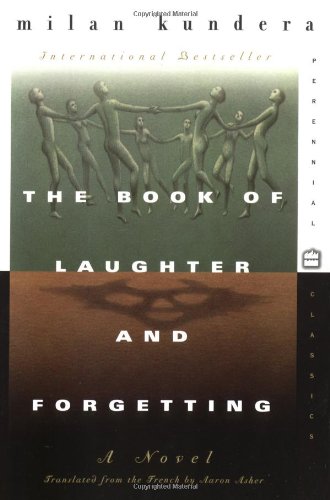

Rich in its stories, characters, and imaginative range, The Book of Laughter and Forgetting is the novel that brought Milan Kundera his first big international success in the late 1970s. Like all his work, it is valuable for far more than its historical implications. In seven wonderfully integrated parts, different aspects of human existence are magnified and reduced, reordered and emphasized, newly examined, analyzed, and experienced.
In one of the finer modern ironies of the life-imitates-art sort, the country that Kundera seemed to be writing about when he talked about Czechoslovakia is, thanks to the latest political redefinitions, no longer precisely there. This kind of disappearance and reappearance is, partly, what Kundera explores in The Book of Laughter and Forgetting. In this polymorphous work — now a novel, now autobiography, now a philosophical treatise — Kundera discusses life, music, sex, philosophy, literature and politics in ways that are rarely politically correct, never classifiable but always original, entertaining and definitely brilliant.
Product Features
- Literature
- The Book of Laughter and Forgetting
- Milan Kundera
Astonishingly Wonderful; A Must-Read THE BOOK OF LAUGHTER AND FORGETTING is a rare and precious jewel. In many ways this is an experimental novel, the seven different parts of the book are compared by the author to Beethoven’s variations upon a musical theme. These different variations either describe, converge upon, or dance around the story of Tamina, a Czech exile who ran away from the communists with her husband only to see him die of disease soon afterward. As time passes she becomes obsessed with the mortal fear that she will forget him. She cannot go back to her homeland but she can try to get her husband’s love letters back, to bring some of his laughter back into her life, to remind her that she is not alone.
Beautiful philosophical – historical – sexual meditation Like Rushdie’s Satanic Verses, this book is largely about angels and devils, or good and evil. The setting is (mostly) Prague around 1970, and the basic political themes — Czech and Russian Communists and their adversaries — are used as a foundation for the more ethereal, philosophical themes, such as the nature of humor, the nature of history, and the differences between the genders.
Depression and Remembering Kundera could not write Laughter and Forgetting without discussing, at some length, their opposites. This overall sad “novel” has elements that are unforgettable. The novel was set in the backdrop of Prague Spring in 1968, when disaffected teachers, writers, and historians, believing that freedom from communism’s bone-crushing anti-intellectualism was within reach, were seduced into tipping their hands, only to be crushed by the Russian invasion that followed in August. Tens of thousands emigrated, while hundreds of thousands were banished from their positions of power and influence. Many went to jail.Similarities between Kundera’s characters and my friends during the heady “flower power” days of the late 60′s here in the USA made the novel ring sadly true and “universal” on a personal level. We were disaffected with the establishment, we felt empowered by our energy, ideals, and our sense of intellectual, political, and sexual freedom. But . . . things didn’t turn out for us the way we had planned them. While the napalm was flowing in Vietnam, the tanks were rolling in Prague, and the National Guard was firing on the students at Kent state, the mistakes that affected us most severely were those that happened in our relationships with friends and lovers. It is quite true that the state will squash -”like a flea between its fingers”- the individual that steps out of its circle of preferred actors and thinkers. But it’s not the state that we have to worry about. The bankruptcy in our lives is usually of our own making, a point which, despite it’s railings against the establishment, The Book of Laughter and Forgetting eloquently makes.While Kundera repeats the sins of the state several times, even opening two chapters with identical accounts of a man erased by the state, his characters fumble with sins of their own. The men, compelled to act out sexual and ego games, lead hollow lives. Ultimately, they must deal with an overwhelming sense of their own failure. The women characters do not fare much better. They get the little joy in life available to them only by forgetting the men they love.Throughout the book, Kundera maintains that it is only by remembering that we can live and make progress. Kundera says we don’t do this very well — as nations or individuals. We try to re-write history – condemning ourselves to repetitive failure. Sound about right?The book is as disturbing as it is wise. Laughter and Forgetting is a good introduction to the rich and complex work of Milos Kundera.